Vehicle Financing and Loan Terms
Complete guide • Step-by-step explanations
Financing Essentials:
Show Financing CalculatorVehicle financing involves understanding key financial concepts including interest rates, loan terms, down payments, and monthly payments. Proper financing decisions can save thousands of dollars over the life of the loan while maintaining financial stability.
Key considerations include:
- Interest Rates: The cost of borrowing money, affecting total loan cost
- Loan Term: Duration of the loan, balancing monthly payments and total interest
- Down Payment: Initial payment reducing principal and interest
- Monthly Payments: Amount paid each month toward loan balance
Smart financing choices balance affordability with minimizing total interest costs.
Loan Calculator
Financing Options
Loan Analysis
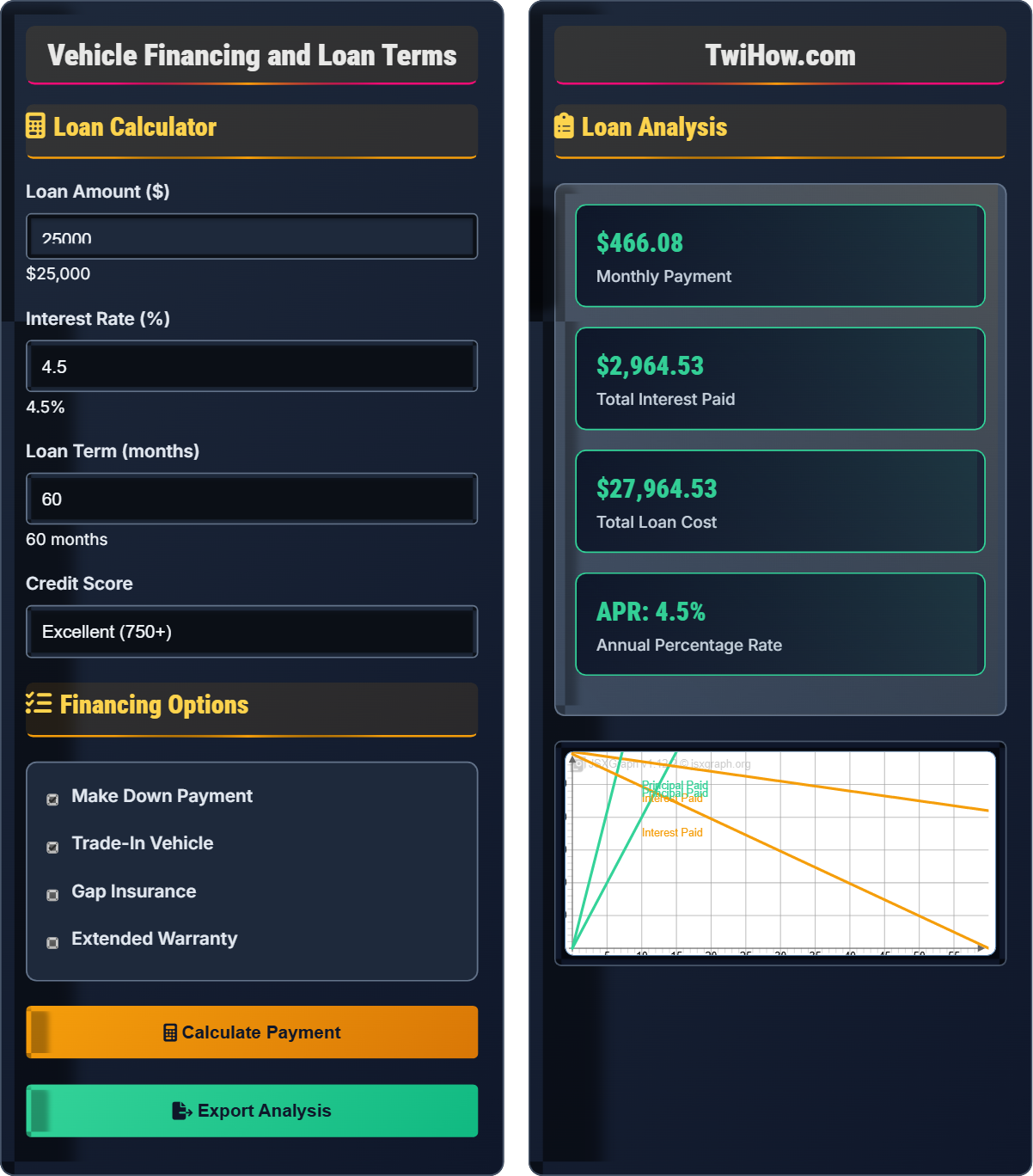
| Item | Amount | Percentage |
|---|---|---|
| Principal | $25,000.00 | 89.4% |
| Interest | $2,964.20 | 10.6% |
| Other Fees | $0.00 | 0.0% |
| Total | $27,964.20 | 100% |
Understanding Vehicle Financing
Vehicle loan payments are calculated using the following formula:
Where:
- P: Principal loan amount
- r: Monthly interest rate (annual rate ÷ 12)
- n: Number of monthly payments
This formula calculates the fixed monthly payment required to pay off the loan over the specified term.
Several factors influence your loan terms and total cost:
- Credit Score: Higher scores typically qualify for lower interest rates
- Down Payment: Larger down payments reduce principal and interest
- Loan Term: Longer terms lower monthly payments but increase total interest
- VIN History: Vehicle condition affects loan eligibility
- Income Stability: Lenders assess debt-to-income ratio
- Employment History: Consistent employment improves approval chances
Be aware of these potential issues:
- Rolling Over Balances: Adding old loan balance to new purchase increases debt
- Gap Insurance: May be unnecessary if you have comprehensive coverage
- Extended Warranties: Often overpriced; research actual value
- Prepayment Penalties: Some loans charge fees for early payoff
- Variable Rates: Interest rates that can increase over time
- Missing Fees: Don't forget taxes, registration, and documentation fees
- Shorter Term (36-48 months): Higher monthly payments, lower total interest
- Longer Term (60-84 months): Lower monthly payments, higher total interest
- Low Rate vs. Cash Back: Calculate which option saves more money
- Fixed vs. Variable: Fixed rates provide payment certainty
- Secured vs. Unsecured: Secured loans typically have lower rates
Financing Essentials
Principal, interest rate, loan term, down payment, credit score, monthly payment, total cost.
Payment = Principal × [Rate(1+Rate)^Term] ÷ [(1+Rate)^Term - 1]
Where Rate = Annual Interest Rate ÷ 12, Term = Number of Months.
- Always get pre-approved before visiting dealers
- Don't finance more than 20% of annual income
- Keep loan terms under 60 months when possible
Credit Impact
Excellent (750+), Good (650-749), Fair (550-649), Poor (Below 550).
- Excellent: Best rates (3-4%)
- Good: Moderate rates (4-6%)
- Fair: Higher rates (6-9%)
- Poor: Highest rates (9-20%)
- Multiple inquiries in short time may impact score
- Payment history affects credit significantly
- Debt-to-income ratio influences approval
- Older credit accounts help your score
Financing & Loan Terms Quiz
How does a 1% increase in interest rate affect a $25,000, 60-month loan?
Using the loan payment formula, a $25,000 loan at 4.5% for 60 months results in a monthly payment of approximately $466. At 5.5%, the payment increases to about $491. This represents an increase of approximately $25 per month. The relationship between interest rate and monthly payment is not linear, but a 1% increase typically results in a $20-30 monthly payment increase for this loan amount and term.
The answer is B) Increases monthly payment by about $25.
Even small differences in interest rates can have a significant impact on monthly payments and total interest paid over the life of the loan. This demonstrates why it's important to shop around for the best rate and understand how credit scores affect borrowing costs. The effect is magnified for larger loans or longer terms.
Interest Rate: Percentage charged for borrowing money
Monthly Payment: Amount paid each month toward loan balance
Principal: Original loan amount before interest
• Small rate changes have significant impacts
• Higher rates increase total interest substantially
• Rate negotiations can save thousands
• Improve credit score before applying
• Compare rates from multiple lenders
• Negotiate rates as well as prices
• Accepting first rate offered
• Not understanding rate impact
• Focusing only on monthly payments
Explain how a down payment affects your vehicle loan and calculate the impact of a $2,000 down payment on a $25,000 vehicle with 4.5% interest over 60 months.
Without Down Payment: $25,000 loan at 4.5% for 60 months results in $466.07 monthly payment and $2,964.20 total interest paid.
With $2,000 Down Payment: $23,000 loan at 4.5% for 60 months results in $428.79 monthly payment and $2,727.40 total interest paid.
Impact: The $2,000 down payment reduces monthly payment by $37.28 and saves $236.80 in interest over the life of the loan. This represents a return of 11.8% on the down payment amount, demonstrating the value of making a down payment.
Down payments also reduce the risk of being upside-down (owing more than the car is worth) and may improve loan terms.
A down payment serves multiple purposes in vehicle financing. It immediately reduces the principal amount borrowed, which decreases both the monthly payment and total interest paid. Additionally, a larger down payment reduces the risk for the lender, potentially qualifying you for better interest rates. The down payment also provides equity in the vehicle from day one, reducing the risk of negative equity if the car depreciates faster than expected.
Down Payment: Initial payment reducing loan principal
Negative Equity: Owning more on loan than vehicle is worth
Principal Reduction: Decrease in loan amount
• Down payments reduce total interest paid
• Aim for at least 20% down when possible
• Consider opportunity cost of down payment
• Use trade-in as down payment
• Save for down payment before shopping
• Consider larger down payment for better terms
• Financing entire vehicle cost
• Not considering down payment alternatives
• Forgetting down payment affects insurance
You're considering two loan options for a $30,000 vehicle: Option A is 48 months at 4.25% interest, Option B is 72 months at 4.5% interest. Calculate the monthly payments and total interest for each option. Which is better financially and why?
Option A (48 months at 4.25%):
Monthly Payment = $683.80, Total Interest = $2,822.40, Total Cost = $32,822.40
Option B (72 months at 4.5%):
Monthly Payment = $477.30, Total Interest = $4,465.60, Total Cost = $34,465.60
Financial Comparison: Option A costs $1,643.20 less overall but has $206.50 higher monthly payments. Option A is financially better as it saves over $1,600 in interest while the vehicle will likely have better resale value after 4 years versus 6 years.
This example illustrates the classic trade-off between monthly payment and total interest cost. While the longer term provides lower monthly payments, it significantly increases the total interest paid over the life of the loan. Additionally, longer terms mean you're paying for a depreciating asset for a longer period, increasing the risk of being upside-down. The shorter term is generally better for those who can afford the higher payments.
Loan Term: Duration of the loan agreement
Total Interest: Cumulative interest paid over loan lifeMonthly Payment: Amount paid each month
• Shorter terms save interest
• Longer terms may lead to negative equity
• Consider total cost, not just monthly payment
• Calculate total interest for each option
• Consider your budget flexibility
• Think about when you plan to trade
• Focusing only on monthly payments
• Not calculating total interest cost
• Ignoring depreciation rates
Your credit score improved from 620 to 720 between applying for a loan and finalizing the purchase. How might this improvement affect your loan terms and what strategies should you employ?
Impact of Credit Improvement: Moving from fair (620) to good (720) credit typically qualifies you for significantly better interest rates. A borrower with a 720 score might receive rates 1-2% lower than someone with a 620 score.
Strategies to Employ:
1. Reapply with New Score: Ask lenders to re-evaluate your application with the improved score
2. Shop Again: Return to lenders you previously applied with to get new quotes
3. Negotiate: Use the improved score as leverage to negotiate better terms
4. Compare Offers: Evaluate new offers against original terms to quantify savings
For a $25,000, 60-month loan, a 1.5% rate reduction could save over $1,800 in interest and reduce monthly payments by about $35.
Credit scores have a direct correlation with interest rates offered by lenders. Improvements in credit scores, even modest ones, can result in substantial savings on vehicle loans. The key is to take advantage of the improved score by re-applying for financing or negotiating better terms. Lenders typically re-check credit scores before finalizing loans, so improvements are often recognized.
Credit Score: Numerical representation of creditworthiness
Interest Rate Spread: Difference between prime rate and borrower rate
Credit Reassessment: Lender review of updated credit information
• Always re-check credit before finalizing
• Scores can improve quickly with good habits
• Better scores open more options
• Monitor credit before major purchases
• Address credit issues early
• Ask for re-evaluation after improvements
• Not taking advantage of score improvements
• Assuming lenders won't update terms
• Missing opportunities to save
Which loan term strategy is generally most cost-effective for borrowers with stable finances?
The most cost-effective strategy is to choose the shortest term that fits comfortably within your budget. Shorter terms result in significantly lower total interest paid over the life of the loan, even though monthly payments are higher. This approach minimizes the cost of borrowing while ensuring you own the vehicle sooner.
The answer is B) Shortest term affordable for lowest total cost.
While longer loan terms reduce monthly payments, they substantially increase the total interest paid over the life of the loan. The optimal strategy balances affordability with cost minimization. Choosing the shortest term you can comfortably afford maximizes the value of your money by reducing the total cost of financing. This approach also means you'll own your vehicle free and clear sooner, freeing up future cash flow.
Loan Term: Duration of the loan agreement
Total Cost of Borrowing: Principal plus all interest paid
Monthly Affordability: Payment that fits in budget comfortably
• Minimize total interest paid
• Don't stretch beyond comfortable monthly payment
• Consider total cost, not just monthly payment
• Calculate total interest for different terms
• Leave buffer room in budget for emergencies
• Consider refinancing if circumstances change
• Focusing only on monthly payments
• Taking maximum term available
• Not calculating total interest cost
FAQ
Q: Should I finance through the dealership or get pre-approved elsewhere?
A: Getting pre-approved before visiting dealerships is generally the better approach. This gives you negotiating power and prevents dealers from marking up interest rates. Banks and credit unions often offer competitive rates, and knowing your approved amount helps you shop within your budget. Once pre-approved, you can still consider dealer financing if they offer a significantly better deal, but having your own financing as a backup puts you in control of the negotiation process.
Q: What's the difference between APR and the interest rate?
A: The interest rate is the percentage charged for borrowing the principal amount. APR (Annual Percentage Rate) includes the interest rate plus other costs like origination fees, closing costs, and other charges associated with the loan. APR gives you a more accurate picture of the total cost of borrowing and is required by law to be disclosed. When comparing loans, always look at the APR rather than just the interest rate to get the true cost of the loan.