Vehicle History Reports in Used Car Purchasing
Complete guide • Step-by-step explanations
Vehicle History Reports:
Show Vehicle Report AnalyzerVehicle history reports play a crucial role in used car purchasing by providing comprehensive information about a vehicle's past, including accidents, maintenance records, title status, ownership history, and more. These reports help buyers make informed decisions and avoid potentially dangerous or costly purchases.
Key components of vehicle history reports include:
- Accident History: Details of reported collisions and damage
- Title Status: Clear, salvage, rebuilt, or lemon titles
- Maintenance Records: Service history and repairs
- Odometer Readings: Mileage verification and tampering detection
- Ownership History: Number of previous owners and registration locations
- Recall Information: Manufacturer recalls and safety notices
Modern vehicle history reports aggregate data from multiple sources including insurance companies, DMVs, repair shops, and government agencies to provide a comprehensive view of a vehicle's past.
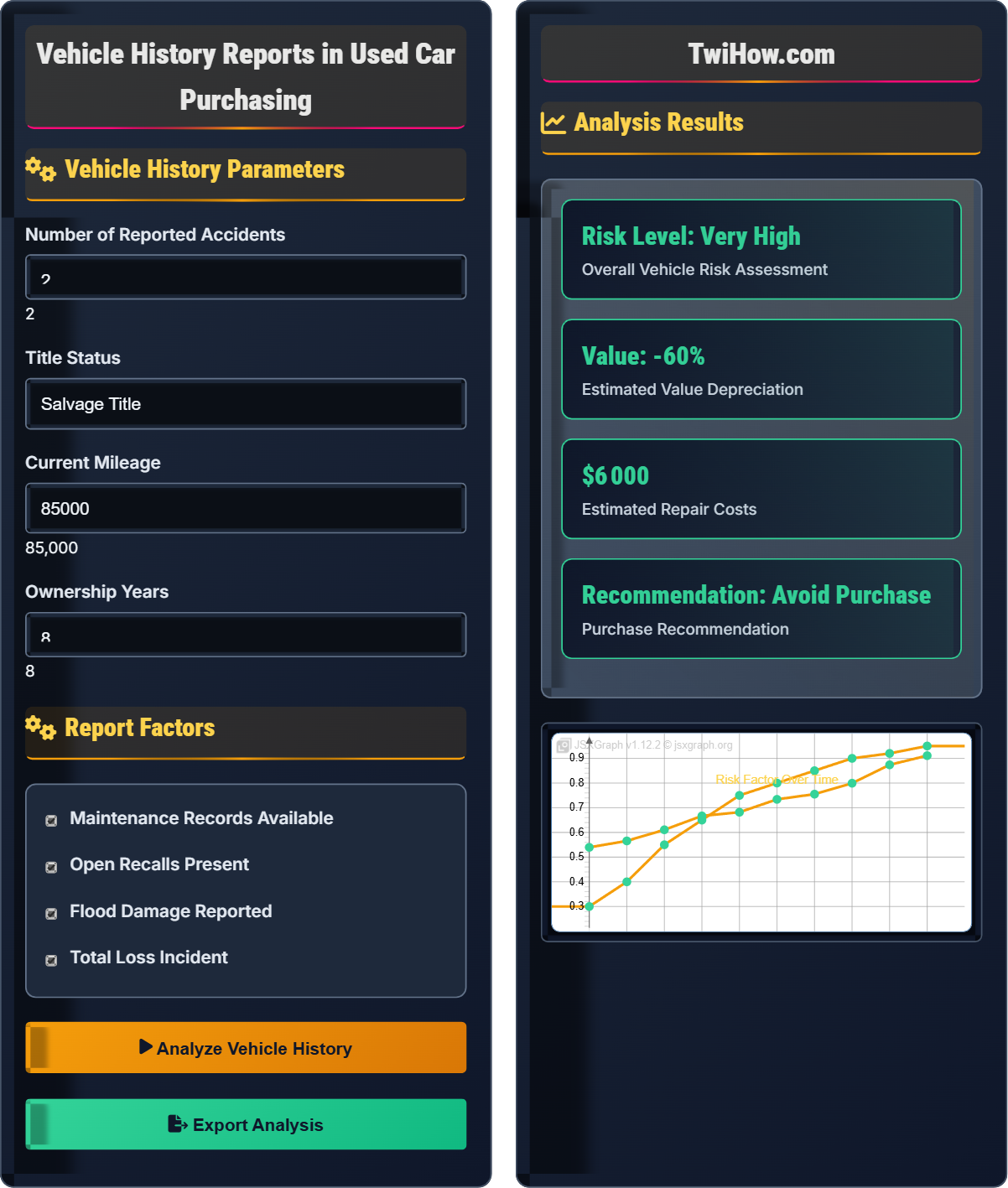
Vehicle History Parameters
Report Factors
Analysis Results
| Factor | Status | Risk Level | Impact |
|---|---|---|---|
| Accident History | 2 incidents | High | -15% value |
| Title Status | Salvage | Very High | -20% value |
| Ownership | 8 years | Medium | +5% value |
| Mileage | 85,000 miles | Low | Neutral |
Vehicle History Reports in Used Car Purchasing
A vehicle history report is a comprehensive document that contains detailed information about a car's past, compiled from various databases including insurance companies, DMVs, repair shops, and government agencies. These reports provide crucial information that helps buyers make informed decisions when purchasing used vehicles.
Vehicle history reports typically include:
Where:
- Accident History: Details of collisions, airbag deployments, and structural damage
- Title Status: Clear, salvage, rebuilt, or lemon law buyback status
- Maintenance Records: Service history and major repairs
- Odometer Readings: Mileage history and tampering indicators
- Ownership History: Number of previous owners and registration locations
- Recall Information: Outstanding manufacturer recalls
Key areas where vehicle history reports provide value:
- Accident Verification: Confirming or disputing seller claims
- Price Negotiation: Justifying lower offers based on issues found
- Safety Assessment: Identifying potential safety hazards
- Insurance Considerations: Understanding coverage implications
- Financing Decisions: Lender requirements for certain title types
- Future Resale Value: Understanding depreciation factors
- Carfax: Most comprehensive consumer database
- AutoCheck: Alternative with different data sources
- Insurance Company Reports: Detailed accident information
- DMV Records: Title and registration history
- Dealer Systems: Internal history databases
Fundamentals of Vehicle History Reports
Vehicle Identification Number (VIN), title status, accident history, odometer rollback, lemon law, salvage title, rebuilt title.
Risk Score = (Accidents × 15) + (Title Issues × 20) + (Mileage Deviation × 10)
Where higher scores indicate greater risk factors.
- Always get a report before purchase
- Compare multiple sources when possible
- Never rely solely on seller disclosure
Applications
Pre-purchase inspection, insurance evaluation, financing approval, resale preparation, warranty verification.
- Private party sales
- Dealer purchases
- Lease returns
- Insurance settlements
- Financing verification
- Report completeness varies by source
- Some incidents may not be reported
- Physical inspection still necessary
Vehicle History Reports Quiz
What does a "salvage" title indicate about a vehicle?
A salvage title indicates that the vehicle was declared a total loss by an insurance company, usually because the cost of repairs exceeded a certain percentage of the vehicle's value (typically 75-80%). This designation stays with the vehicle permanently and significantly affects its value and insurability. Vehicles with salvage titles may have structural damage, flood damage, or other serious issues.
The answer is B) The vehicle was declared a total loss by an insurance company.
Understanding title status is crucial when purchasing used vehicles. A salvage title indicates the vehicle has a permanent record of severe damage. Even if repaired, these vehicles may have lingering mechanical, electrical, or structural issues. Insurance companies often charge higher premiums or refuse coverage for salvage-titled vehicles. Buyers should be extremely cautious and consider the long-term costs and risks associated with these vehicles.
Salvage Title: Permanent designation for vehicles declared total loss by insurers
Total Loss: When repair costs exceed a percentage of vehicle value
Rebuilt Title: Given to salvage vehicles that have been repaired and inspected
• Salvage titles cannot be removed from vehicle records
• These vehicles often have higher insurance costs
• Thorough inspection is essential before purchase
• Avoid if possible for safety reasons
• Get independent inspection if considering
• Research insurance implications beforehand
• Not understanding the permanence of salvage titles
• Underestimating repair costs
• Ignoring insurance implications
Explain how to identify potential odometer fraud and describe the steps to verify mileage accuracy.
Signs of Odometer Fraud: Look for inconsistent wear on pedals and steering wheel compared to dashboard mileage, maintenance records that don't match mileage, and unusual wear patterns on seats and controls.
Verification Steps:
1. Vehicle History Report: Check for mileage readings at different points in time
2. Service Records: Compare reported mileage with service intervals
3. Physical Inspection: Look for signs of tampering around the instrument cluster
4. Professional Inspection: Have a mechanic assess wear patterns
5. DMV Records: Request title history showing mileage at transfer points
Odometer fraud is a serious issue that can significantly impact vehicle value and safety. Sellers may roll back odometers to increase perceived value, but this also hides the true age and wear of the vehicle. The discrepancy between indicated mileage and actual wear can lead to unexpected mechanical failures and safety issues. Always verify mileage through multiple sources before purchasing.
Odometer Fraud: Illegally altering vehicle mileage reading
Mileage Rollback: Deliberately reducing odometer reading
Truth in Mileage Act: Federal law prohibiting odometer tampering
• Always check vehicle history reports for mileage consistency
• Compare wear patterns with reported mileage
• Verify with multiple data sources
• Look for maintenance records at regular intervals
• Check for inconsistent wear on interior components
• Ask for service receipts as verification
• Taking seller's word about mileage
• Not verifying through multiple sources
• Ignoring inconsistent wear patterns
You're considering a 5-year-old sedan with 65,000 miles that was involved in a front-end collision at 25 mph. The repair cost was $8,000, and the vehicle has a clean title. The dealer is offering it for $18,000. Calculate the estimated value impact and recommend a negotiation strategy.
Typical Depreciation: Minor accidents (under $5,000 repairs) cause 10-15% value loss, major accidents (over $5,000) cause 20-25% value loss
Estimated Impact: $18,000 × 0.22 = $3,960 value reduction
Adjusted Value: $18,000 - $3,960 = $14,040
Negotiation Strategy: Point out the accident history and use the vehicle history report as justification for a lower price. Request documentation of the repairs and quality verification. Consider asking for additional warranties or services to offset the risk.
Additional Considerations: Verify that the repair was done properly and check for any ongoing issues related to the accident.
Accident history significantly impacts vehicle value, even when repairs are done properly. The severity of the accident, type of damage, and repair quality all influence the long-term value and reliability of the vehicle. Professional repairs can restore functionality but cannot eliminate the psychological impact of knowing the vehicle was in an accident. This is reflected in resale values and buyer preferences.
Diminished Value: Reduction in market value due to accident history
Structural Damage: Damage to frame or unibody structure
Non-Structural Damage: Cosmetic or minor component damage
• Higher repair costs correlate with greater value impact
• Structural damage has more severe impact than cosmetic
• Proper repairs can minimize but not eliminate impact
• Research comparable clean-vehicle pricing
• Ask for repair documentation
• Have mechanic inspect for hidden damage
• Not accounting for diminished value
• Accepting seller's repair claims without verification
• Ignoring potential future issues
A vehicle history report shows that a car you're interested in was located in a flood zone during Hurricane Sandy. The report doesn't explicitly state flood damage, but the mileage seems unusually low for the vehicle's age. What should you look for during inspection and what are the potential long-term effects of hidden flood damage?
Inspection Areas:
1. Undercarriage: Look for rust, debris, or unusual residue
2. Interior: Check for musty odors, water stains, or replacement carpeting
3. Electrical Systems: Test all electronic components and look for corrosion
4. Engine Bay: Look for sand, silt, or unusual deposits
Potential Effects: Electrical failures, rust progression, mold growth, and premature component failure. Flood-damaged vehicles often develop problems months or years after the incident.
Flood damage can be difficult to detect, especially if the vehicle was dried out and cleaned. Water can cause long-term damage to electrical systems, promote rust formation, and create health hazards from mold. The damage may not be immediately apparent, but can manifest months later in the form of electrical failures, strange noises, or odors. This is why thorough inspection is crucial when a vehicle has been in a flood-prone area.
Flood Damage: Water intrusion causing mechanical and electrical damage
Diminished Value: Reduced resale value due to flood history
Secondary Damage: Problems that emerge after initial flood damage
• Even without explicit flood damage, be cautious in flood zones
• Electrical issues may not appear immediately
• Mold can cause health issues long-term
• Hire professional inspector for suspected flood damage
• Smell for mustiness in cabin and trunk
• Check for unusual rust patterns
• Assuming no visible damage means no problems
• Not inspecting electrical systems thoroughly
• Ignoring undercarriage inspection
What does a "lemon law buyback" title indicate about a vehicle?
A lemon law buyback title indicates that the vehicle was returned to the manufacturer under state lemon laws because it had recurring defects that couldn't be repaired within a reasonable number of attempts. The manufacturer bought back the vehicle from the consumer and then resold it, but the lemon law buyback designation remains on the title permanently. These vehicles often have unresolved or recurring issues that were difficult to fix initially.
The answer is A) The vehicle was returned to the manufacturer under warranty.
Lemon law buybacks represent vehicles that had persistent problems during the warranty period. Even though they were repurchased by the manufacturer, they may still have underlying issues that weren't fully resolved. The lemon law designation is permanent and significantly affects resale value. Buyers should be aware that these vehicles may have recurring problems and may be more difficult to sell in the future.
Lemon Law Buyback: Vehicle returned under state warranty protection laws
State Lemon Laws: Consumer protection for defective vehicles
Buyback Vehicle: Returned to manufacturer and resold
• Lemon law buybacks have permanent title designation
• May still have recurring issues despite repairs
• Significantly reduced resale value
• Avoid if possible due to reliability concerns
• Get detailed inspection if considering
• Understand limited warranty coverage
• Not understanding permanence of lemon law designation
• Assuming all issues were resolved
• Underestimating future repair costs
FAQ
Q: How many vehicle history reports should I get for one car?
A: I recommend getting at least two different vehicle history reports from different providers (like Carfax and AutoCheck) because they pull from different databases. Some information may be exclusive to one provider or the other. Additionally:
Primary Report: One comprehensive report (Carfax or AutoCheck) for detailed history
Secondary Check: Another provider to cross-reference key information
Free Options: Use free services like VinAudit for basic checks
Specialized Reports: Get specific reports if there are particular concerns (insurance history, auction records)
Remember that reports aren't perfect and should be combined with a thorough physical inspection and professional evaluation.
Q: What are the most important things to look for in a vehicle history report?
A: The most critical elements in a vehicle history report are:
Title Status: Look for salvage, rebuilt, lemon law buyback, or flood designations
Accident History: Severity and frequency of reported incidents
Mileage Consistency: Check for sudden drops or irregular patterns suggesting rollback
Ownership Patterns: Frequent ownership changes may indicate problems
Recall Status: Outstanding safety recalls that need attention
Registration History: Where the vehicle was registered (flood zones, etc.)
Usage Type: Rental, taxi, or commercial use can affect value and reliability
These factors directly impact safety, reliability, value, and long-term costs of ownership.