How do I advocate for sustainable and zero-emission transit fleets?
Urban mobility guide • Step-by-step advocacy
Zero Emission Transit:
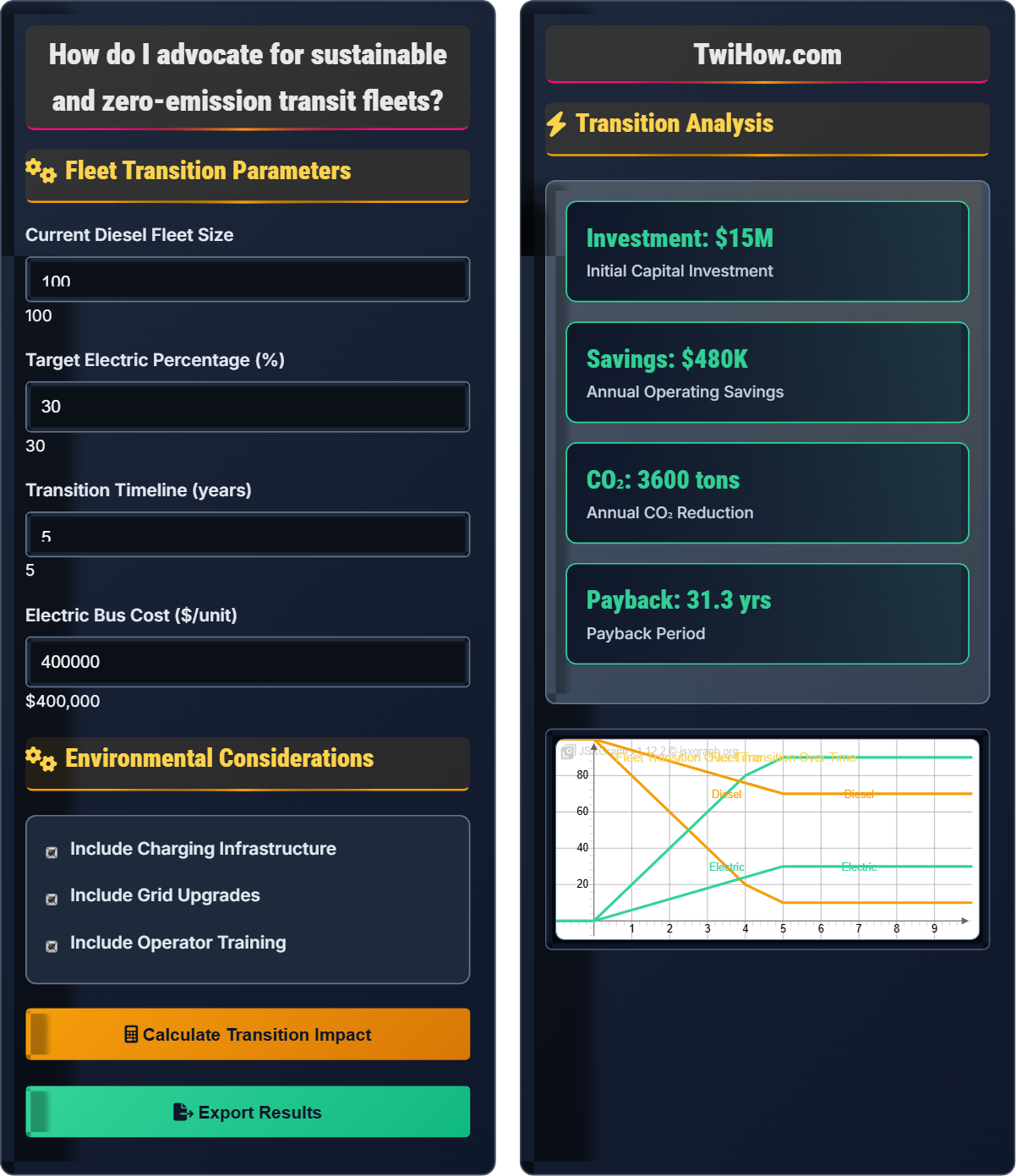
Show Fleet Analysis ToolAdvocating for sustainable and zero-emission transit fleets involves promoting electric buses, hydrogen fuel cell vehicles, and other clean technologies to replace diesel-powered transit. This approach reduces greenhouse gas emissions, air pollution, and operational costs while improving public health outcomes.
Key advocacy strategies include building coalitions, presenting economic arguments, leveraging environmental benefits, and engaging with policymakers and transit authorities.
Major components of sustainable transit advocacy include:
- Technology Options: Electric, hydrogen, and hybrid alternatives
- Economic Case: Lifecycle cost analysis and funding opportunities
- Environmental Impact: Air quality and climate benefits
- Community Health: Reduced pollution exposure
Successful advocacy requires understanding technical, economic, and political dimensions while building broad support for clean transportation initiatives.
Fleet Transition Parameters
Environmental Considerations
Transition Analysis
| Category | Amount | Timeline | Impact |
|---|---|---|---|
| Electric Buses | $12M | Year 1-3 | High |
| Charging Infrastructure | $2M | Year 1-2 | Medium |
| Grid Upgrades | $1.5M | Year 1 | Medium |
| Training | $0.5M | Year 1 | Low |
Clean Energy Transit Solution
Zero-Emission Transit Advocacy Explained
Zero-emission transit refers to public transportation systems powered entirely by electricity, hydrogen fuel cells, or other clean energy sources that produce no direct tailpipe emissions. This includes electric buses, hydrogen fuel cell buses, and electric trains powered by renewable energy sources.
The financial case for zero-emission transit involves upfront capital costs offset by long-term operational savings:
Where:
- Annual Savings: Fuel, maintenance, and operational cost reductions
- r: Discount rate reflecting time value of money
- n: Useful life of electric fleet assets
- Initial Investment: Purchase of electric buses and infrastructure
Zero-emission transit delivers significant environmental advantages:
- GHG Reduction: Eliminates direct carbon emissions from transit operations
- Air Quality: Removes particulates and nitrogen oxides from urban areas
- Climate Impact: Supports carbon neutrality goals
- Noise Pollution: Quieter operation improves urban acoustics
- Energy Efficiency: Electric motors are more efficient than combustion engines
- Renewable Integration: Enables use of clean electricity sources
- Federal Grants: EPA Clean Air Act, DOT TIGER/BUILD programs
- State Programs: California's AB 1232, similar state initiatives
- Utility Partnerships: Incentives for grid electrification
- Green Bonds: Municipal financing for environmental projects
- Carbon Credits: Revenue from emissions reduction programs
Advocacy Fundamentals
Zero-emission transit, electric buses, hydrogen fuel cells, environmental advocacy, fleet transition, clean energy.
Net Present Value = Σ(Annual Savings_t / (1+r)^t) - Initial Investment
Where NPV = economic viability indicator, r = discount rate.
- Electric buses have lower lifecycle costs
- Infrastructure investment is critical
- Community support accelerates adoption
Implementation
Charging infrastructure, battery technology, grid integration, operator training, maintenance protocols.
- Conduct feasibility study
- Secure financing and funding
- Procure equipment and infrastructure
- Train personnel and operators
- Range and charging logistics
- Grid capacity requirements
- Upfront capital investment
- Technical support availability
Zero-Emission Transit Learning Quiz
Which of the following is NOT a viable zero-emission technology for transit buses?
Zero-emission transit technologies produce no direct emissions during operation. While hybrid electric buses reduce emissions compared to conventional diesel buses, they still burn fossil fuels and produce emissions. Natural gas buses, though cleaner than diesel, still emit carbon dioxide and other pollutants.
The answer is D) Natural gas buses.
It's important to distinguish between "low-emission" and "zero-emission" technologies. True zero-emission transit relies entirely on stored electrical energy (batteries) or chemical energy (hydrogen) converted to electricity, producing no direct emissions. Hybrid systems still rely on internal combustion engines part of the time, resulting in some emissions.
Zero Emission: No direct emissions from vehicle operation
Hybrid Electric: Combination of electric motor and internal combustion engine
Fuel Cell: Converts hydrogen and oxygen to electricity and water
• Direct emissions must be zero
• Power source must be renewable
• Full lifecycle considered for carbon neutrality
• Look for "true" zero-emission technologies
• Consider energy source for electricity
• Verify no tailpipe emissions
• Confusing low-emission with zero-emission
Explain the economic arguments for transitioning to electric transit buses. How do lifecycle costs compare to diesel buses?
Initial Costs: Electric buses cost significantly more upfront (typically $300K-$500K vs $300K for diesel), plus charging infrastructure costs.
Operating Savings: Electric buses have 30-50% lower fuel costs (electricity vs diesel) and 40-60% lower maintenance costs (fewer moving parts).
Lifecycle Analysis: Over 12-15 year lifespan, total cost of ownership for electric buses is often 15-30% lower than diesel.
Additional Benefits: Reduced noise complaints, improved rider comfort, and potential revenue from demand response programs.
Payback Period: Typically 5-10 years depending on electricity costs and utilization rates.
While electric buses have higher upfront costs, the economic case is compelling when considering the full lifecycle. The key is to focus on total cost of ownership rather than purchase price alone. Electric motors have fewer moving parts than diesel engines, leading to significantly lower maintenance requirements and longer lifespans.
Total Cost of Ownership (TCO): All costs over asset lifecycle
Payback Period: Time to recover initial investment
Life Cycle Assessment: Environmental impact over entire lifecycle
• Consider all operational costs
• Factor in utility incentives
• Account for maintenance savings
• Calculate fuel cost savings
• Estimate maintenance reduction
• Include environmental benefits
• Only comparing purchase prices
• Ignoring maintenance savings
• Not accounting for utility rebates
A city with 200 diesel buses wants to transition 50% of its fleet to electric over 5 years. Each electric bus costs $400,000 and charging infrastructure adds $50,000 per bus. Federal grants cover 50% of costs and state programs contribute $10 million. Calculate the total municipal investment required and the annual budget allocation needed for the transition.
Bus Count: 200 × 0.5 = 100 electric buses
Bus Cost: 100 × $400,000 = $40,000,000
Infrastructure Cost: 100 × $50,000 = $5,000,000
Total Cost: $40,000,000 + $5,000,000 = $45,000,000
Federal Grant: $45,000,000 × 0.5 = $22,500,000
State Contribution: $10,000,000
Municipal Investment: $45,000,000 - $22,500,000 - $10,000,000 = $12,500,000
Annual Budget: $12,500,000 ÷ 5 years = $2,500,000 per year
The city needs to allocate $2.5 million annually for 5 years to complete the transition.
This problem demonstrates how federal and state funding can significantly reduce the municipal burden of transitioning to electric fleets. The key insight is that government programs often cover 50-80% of costs, making zero-emission transitions more financially feasible for local governments.
Total Cost of Ownership: All expenses over asset lifecycle
Grant Coverage: Percentage of costs funded by government
Annual Allocation: Budget amount needed per year
• Calculate infrastructure separately
• Research all available grants
• Consider phased implementation
• Calculate per-bus costs
• Forgetting infrastructure costs
• Not accounting for all funding
• Ignoring annual budget requirements
A transit agency serves a low-income community with high rates of asthma and other respiratory diseases. The agency operates 80 diesel buses that pass through the community daily. How would you frame the zero-emission transition as a public health imperative? What data would strengthen your advocacy message?
Health Argument: Diesel exhaust contains fine particulates (PM2.5), nitrogen oxides (NOx), and carcinogens that worsen asthma and cardiovascular disease. Replacing diesel buses with electric ones would eliminate these exposures.
Supporting Data:
• Local health statistics (asthma rates, hospitalizations)
• Air quality measurements near bus routes
• Studies linking diesel emissions to respiratory illness
• Economic cost of health impacts (medical expenses, lost work)
• Comparison of emissions per bus (0 g/mile for electric vs 0.01 g/mile for diesel)
This framing emphasizes equity and environmental justice as key advocacy pillars.
Public health arguments can be particularly compelling for zero-emission advocacy, especially in communities already facing environmental burdens. The connection between diesel emissions and respiratory health is well-established scientifically, making this a powerful advocacy tool. Combining health impacts with environmental justice concerns creates a strong moral argument.
Environmental Justice: Fair treatment regardless of race or income
Particulate Matter: Fine particles harmful to respiratory health
Environmental Burden: Disproportionate pollution exposure
• Link emissions to health outcomes
• Use local data for relevance
• Emphasize vulnerable populations
• Partner with health organizations
• Gather community testimonials
• Use peer-reviewed research
• Not connecting to local health issues
• Using generic instead of local data
• Ignoring community voices
What is the most critical infrastructure requirement for electric bus deployment?
Electric buses require high-capacity charging infrastructure to operate effectively. This includes depot chargers for overnight charging and potentially opportunity chargers at terminals. The electrical grid must be upgraded to handle the significant power demands, which can exceed 1 MW for a fleet of 20-30 buses.
The answer is B) High-capacity electrical charging systems.
While electric buses themselves are expensive, the infrastructure requirements often represent an even larger investment. The electrical grid must be upgraded to handle the power demands, which can strain local utilities. Charging infrastructure must be carefully planned to ensure buses receive adequate charge for their routes without overloading the electrical system.
Depot Charging: Overnight charging at bus maintenance facility
Opportunity Charging: Fast charging during layovers
Grid Capacity: Electrical system's power delivery capability
• Plan charging infrastructure early
• Coordinate with utility companies
• Consider peak demand impacts
• Schedule charging during off-peak hours
• Consider solar integration
• Plan for future expansion
• Underestimating infrastructure costs
• Not planning for grid upgrades
• Ignoring utility coordination
FAQ
Q: How can we address concerns about electric bus range and reliability for longer routes?
A: Range anxiety for electric buses can be addressed through several strategies:
1. Route Optimization: Select routes with sufficient charging opportunities and shorter average lengths
2. Fast Charging: Install opportunity charging at terminals for quick top-offs
3. Battery Technology: Choose buses with sufficient range for your routes (modern buses can travel 150-200+ miles)
4. Operational Adjustments: Modify schedules to accommodate charging breaks
5. Hybrid Approach: Deploy electric buses on shorter routes, conventional on longer ones initially
Many cities have successfully operated electric buses on routes exceeding 200 miles per day.
Q: What are the most effective ways to build political support for zero-emission transit?
A: Effective political advocacy for zero-emission transit involves multiple approaches:
Coalition Building: Partner with environmental groups, health organizations, labor unions, and community leaders to demonstrate broad support.
Economic Arguments: Present clear cost-benefit analyses showing long-term savings and job creation potential.
Local Impact: Emphasize health benefits for vulnerable communities and improved quality of life.
Peer Examples: Showcase successful implementations in comparable cities.
Stakeholder Engagement: Involve transit workers, riders, and community members in the planning process.
Combining economic, health, and environmental arguments creates the strongest political case.