Advocating for Equitable & Sustainable Transit Investments
Complete guide • Step-by-step explanations
Equitable & Sustainable Transit:
Show Advocacy SimulatorAdvocating for equitable and sustainable transit investments requires understanding the intersection of social justice, environmental sustainability, and economic development. Effective advocacy combines community engagement, data-driven arguments, and strategic coalition building to influence policy decisions that prioritize underserved communities and environmental stewardship.
Key advocacy areas include:
- Equity Focus: Prioritizing historically underserved communities
- Environmental Justice: Addressing pollution and climate impacts
- Sustainability Goals: Reducing carbon emissions and promoting green mobility
- Community Voice: Ensuring meaningful participation in planning
- Long-term Vision: Building resilient, future-ready transit systems
- Funding Equity: Allocating resources fairly across communities
Successful advocacy requires building coalitions, presenting compelling data, and demonstrating both immediate and long-term benefits of equitable and sustainable transit investments.
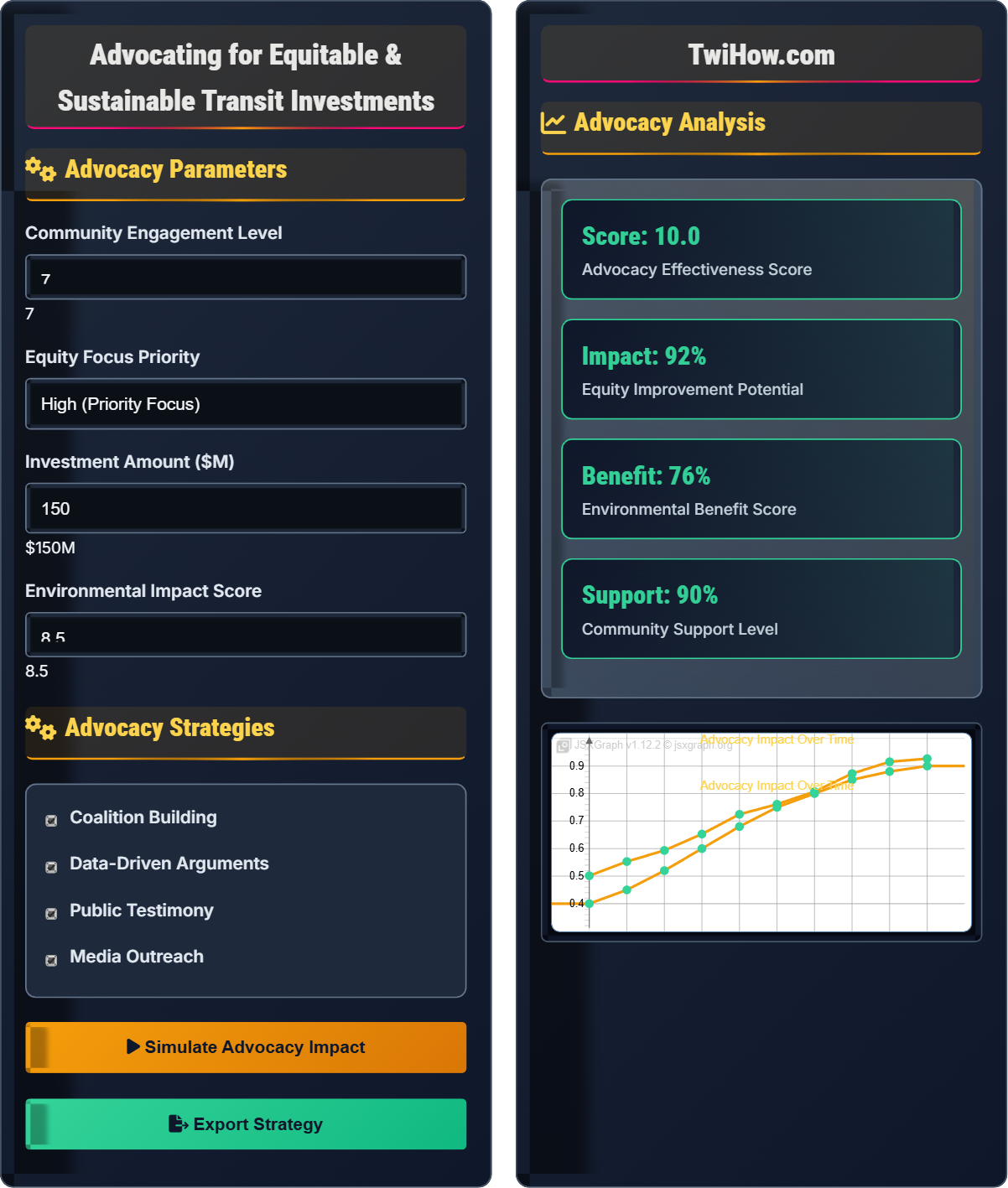
Advocacy Parameters
Advocacy Strategies
Advocacy Analysis
| Strategy | Effectiveness | Community Impact | Environmental Benefit |
|---|---|---|---|
| Coalition Building | 90% | 85% | 70% |
| Data-Driven Arguments | 85% | 75% | 80% |
| Public Testimony | 80% | 90% | 65% |
| Media Outreach | 75% | 70% | 75% |
Advocating for Equitable & Sustainable Transit Investments
Transit advocacy is the organized effort to influence policy decisions and resource allocation to ensure that public transportation investments serve all community members equitably while promoting environmental sustainability. This includes engaging with decision-makers, mobilizing community voices, and presenting evidence-based arguments for transit improvements.
Effective transit advocacy follows a structured approach:
Where:
- Community Engagement: Level of grassroots participation and support
- Data Quality: Strength and relevance of evidence presented
- Strategic Coalition: Effectiveness of partnerships and alliances
- Barriers: Institutional and political obstacles
- Opposition Strength: Resistance from opposing interests
- Policy Window: Timing and political opportunity
Key areas where equity-focused transit advocacy applies:
- Service Expansion: Ensuring new routes serve underserved communities
- Fare Policy: Advocating for affordable and equitable fare structures
- Station Location: Prioritizing access for disadvantaged neighborhoods
- Environmental Justice: Addressing pollution in transit-dependent communities
- Job Access: Connecting residents to employment opportunities
- Health Equity: Improving access to healthcare and services
- Community Organizing: Mobilizing grassroots support and participation
- Data Visualization: Using maps and charts to demonstrate inequities
- Coalition Building: Partnering with diverse stakeholders
- Storytelling: Sharing personal experiences and testimonials
- Policy Analysis: Examining funding allocations and decision-making
- Media Engagement: Raising public awareness and support
Fundamentals of Transit Advocacy
Transit equity, environmental justice, community engagement, sustainable transportation, advocacy strategies, policy influence, grassroots organizing.
Advocacy Success = (Community Support × Data Strength × Strategic Positioning) / (Resistance × Complexity)
Where higher values indicate greater likelihood of achieving advocacy goals.
- Center community voices in advocacy efforts
- Use data to support equity arguments
- Build diverse coalitions for broader support
Applications
Transit planning processes, budget advocacy, environmental reviews, service expansion, fare policy changes, station development, corridor planning.
- Regional transportation planning
- Local transit board meetings
- Environmental impact assessments
- Funding allocation processes
- Community development initiatives
- Historical disinvestment patterns
- Community trust and engagement
- Political and institutional barriers
Transit Advocacy Quiz
What is the primary concern of environmental justice in transit planning?
Environmental justice focuses on preventing the disproportionate placement of polluting infrastructure in minority and low-income communities. These communities have historically borne a greater burden of environmental hazards while having less access to environmental benefits. Transit advocacy must ensure that new projects don't perpetuate these inequities.
The answer is B) Ensuring minority and low-income communities are not disproportionately burdened by pollution.
Environmental justice recognizes that pollution and environmental hazards are not evenly distributed across communities. Low-income and minority communities often face higher exposure to air pollution, noise, and other environmental burdens while having less access to parks, clean air, and other environmental benefits. Transit advocacy must address these historical inequities.
Environmental Justice: Fair treatment of all people regarding environmental policies
Environmental Racism: Disproportionate environmental burdens on communities of color
Disproportionate Burden: Greater environmental impact on marginalized communities
• Identify existing environmental burdens in communities
• Ensure new projects don't worsen existing inequities
• Advocate for environmental benefits in underserved areas
• Map existing pollution sources alongside transit plans
• Engage environmental justice advocates in coalitions
• Use demographic data to identify vulnerable communities
• Not considering cumulative environmental impacts
• Focusing only on positive benefits
• Ignoring community environmental concerns
Explain the importance of meaningful community engagement in transit advocacy and describe strategies for effective engagement.
Importance of Meaningful Engagement: Meaningful community engagement ensures that transit investments truly serve the needs of residents, builds trust between agencies and communities, and creates sustainable support for projects. It helps identify local priorities, concerns, and solutions that might not be apparent to outside planners.
Effective Engagement Strategies:
1. Accessible Meetings: Hold meetings in convenient locations with childcare and translation services
2. Multiple Channels: Use online surveys, door-to-door outreach, and community events
3. Early Involvement: Engage communities before decisions are made
4. Feedback Loops: Show how community input influenced decisions
5. Leadership Development: Train community members to advocate effectively
6. Long-term Relationships: Maintain engagement beyond single projects
Meaningful engagement goes beyond token consultation to genuine partnership. Communities must have real influence over decisions that affect them. This requires creating multiple pathways for participation, accommodating different schedules and preferences, and demonstrating that input leads to actual changes. Trust is built through consistent follow-through and transparent communication.
Meaningful Engagement: Genuine community involvement in decision-making
Token Consultation: Superficial community input without real influence
Participatory Planning: Community-led planning processes
• Community members should lead their own advocacy efforts
• Engagement must happen early in the process
• Feedback mechanisms must be transparent and responsive
• Partner with trusted community organizations
• Use culturally appropriate communication methods
• Compensate community members for their time
• Holding meetings only during work hours
• Not providing translation services
• Consulting only English-speaking residents
A city has 4 neighborhoods with different income levels and transit access. Neighborhood A (high income) has 10 bus routes and 2 subway lines. Neighborhood B (middle income) has 5 bus routes and 1 subway line. Neighborhood C (low income) has 2 bus routes and no subway access. Neighborhood D (very low income) has 1 bus route and no subway access. The city is planning to add 4 new bus routes. How should equity-focused advocacy prioritize the new routes to address existing disparities?
Current Disparities:
• Neighborhood A: 12 total routes per capita (highest access)
• Neighborhood B: 6 total routes per capita (medium access)
• Neighborhood C: 2 total routes per capita (low access)
• Neighborhood D: 1 total route per capita (lowest access)
Equity-Focused Solution: The new routes should prioritize neighborhoods with the lowest access:
• 2 routes to Neighborhood D (increasing access from 1 to 3)
• 1 route to Neighborhood C (increasing access from 2 to 3)
• 1 route to Neighborhood B (increasing access from 6 to 7)
Result: This approach reduces the disparity between neighborhoods and prioritizes the most underserved areas, aligning with equity principles.
This example demonstrates the principle of prioritizing investments in areas with the greatest need. Rather than simply adding to areas that already have good service (which would increase disparities), equity-focused advocacy seeks to level the playing field by investing in underserved communities. This approach recognizes that equal treatment (same service everywhere) is not the same as equitable treatment (service proportional to need).
Transit Equity: Fair distribution of transit services across communities
Equal vs. Equitable: Same treatment vs. proportional to need
Service Disparities: Differences in transit access across communities
• Prioritize underserved communities first
• Address existing disparities in planning
• Use data to demonstrate inequities
• Create maps showing service disparities
• Use demographic data to identify underserved areas
• Advocate for explicit equity criteria in planning
• Distributing resources equally regardless of need
• Not using data to demonstrate disparities
• Failing to advocate for explicit equity policies
You're advocating for a transit project that would benefit low-income communities but faces opposition from environmental groups concerned about construction impacts. How would you build a coalition to support the project while addressing environmental concerns?
Coalition Building Strategy:
1. Identify Common Ground: Both communities want healthy environments and economic opportunities
2. Engage Environmental Justice Groups: Partner with organizations focused on environmental justice rather than just environmental protection
3. Propose Mitigation Measures: Advocate for construction practices that minimize environmental impacts
4. Highlight Long-term Benefits: Emphasize how improved transit reduces long-term pollution
5. Include Diverse Voices: Bring together labor unions, faith organizations, and community groups
6. Address Construction Concerns: Push for worker safety, local hiring, and noise mitigation
Result: A broad coalition that addresses both equity and environmental concerns.
Effective advocacy often requires bridging seemingly competing interests. Environmental and equity concerns are not mutually exclusive - both aim to create healthier, more sustainable communities. The key is finding shared values and demonstrating how the proposed solution addresses multiple concerns simultaneously. This requires careful listening, creative problem-solving, and patience in building consensus.
Environmental Justice: Intersection of environmental and equity concerns
Stakeholder Coalition: Diverse group united around common goals
Common Ground: Shared values and objectives across groups
• Listen to all stakeholders' concerns
• Find shared values and common goals
• Address legitimate concerns through design modifications
• Engage stakeholders early in the process
• Acknowledge legitimate concerns
• Propose concrete solutions to address concerns
• Assuming all environmental groups oppose transit
• Not addressing construction impacts seriously
• Failing to engage stakeholders early
Which type of data is most compelling for demonstrating transit equity needs?
Per capita transit access by neighborhood demographics is most compelling because it directly demonstrates disparities in service provision relative to community characteristics. This data shows whether transit investments are equitably distributed across different income levels, racial groups, and other demographic factors, making the case for equity-focused investments.
The answer is B) Per capita transit access by neighborhood demographics.
Effective advocacy uses data to tell a story about inequity. Raw numbers like overall ridership don't reveal disparities between communities. Per capita analysis normalizes for population differences, while demographic analysis reveals patterns of inequality. Maps and visualizations of this data can powerfully illustrate the need for equity-focused investments to decision-makers and the public.
Per Capita Analysis: Measurements normalized by population size
Demographic Mapping: Geographic analysis of population characteristics
Data Visualization: Charts and maps that tell stories
• Use comparative analysis to show disparities
• Normalize data for fair comparisons
• Visualize data to make it compelling
• Create before-and-after maps showing proposed improvements
• Use demographic data from census and ACS
• Compare service levels across different income areas
• Using raw numbers instead of per capita measures
• Not comparing across demographic groups
• Failing to visualize data effectively
FAQ
Q: How can we build effective coalitions for transit equity advocacy?
A: Building effective coalitions requires:
Shared Values: Identify common goals like healthy communities, economic opportunity, and environmental protection
Diverse Partners: Include community organizations, environmental groups, labor unions, faith organizations, and business associations
Clear Roles: Define how each partner contributes and benefits
Regular Communication: Maintain ongoing dialogue and information sharing
Democratic Process: Ensure all voices are heard in decision-making
Resource Sharing: Pool funding, staff, and other resources
Long-term Commitment: Build relationships that extend beyond single campaigns
Successful coalitions amplify voices and create broader political support for equity-focused transit investments.
Q: What are the main challenges in implementing equitable transit investments?
A: Main challenges include:
Historical Disinvestment: Decades of unequal investment patterns are difficult to reverse
Political Resistance: Existing power structures may resist change
Funding Constraints: Limited resources for comprehensive equity investments
Technical Barriers: Complex planning processes that may not prioritize equity
Community Trust: Historical mistreatment may make engagement difficult
Measurement Challenges: Difficulty in defining and measuring equity outcomes
Short-term Focus: Political cycles favor quick wins over long-term equity goals
Addressing these challenges requires sustained advocacy, policy reforms, and institutional changes.