Evaluating the Future of Autonomous & On-Demand Transit Services
Complete guide • Step-by-step explanations
Autonomous & On-Demand Transit:
Show Future SimulatorThe future of autonomous and on-demand transit services represents a convergence of advanced technology, changing mobility patterns, and evolving urban planning approaches. These emerging services promise to revolutionize how people move through cities by offering personalized, efficient, and sustainable transportation options that complement traditional public transit.
Key evaluation areas include:
- Technology Maturity: Sensor systems, AI, and connectivity advancements
- Regulatory Framework: Safety standards, liability, and operational guidelines
- Market Adoption: Consumer acceptance and behavioral shifts
- Integration Potential: Coordination with existing transit networks
- Economic Viability: Cost-effectiveness and business model sustainability
- Social Impact: Accessibility, equity, and urban development effects
Successful evaluation requires understanding technological capabilities, market dynamics, and societal needs to predict realistic adoption timelines and impacts.
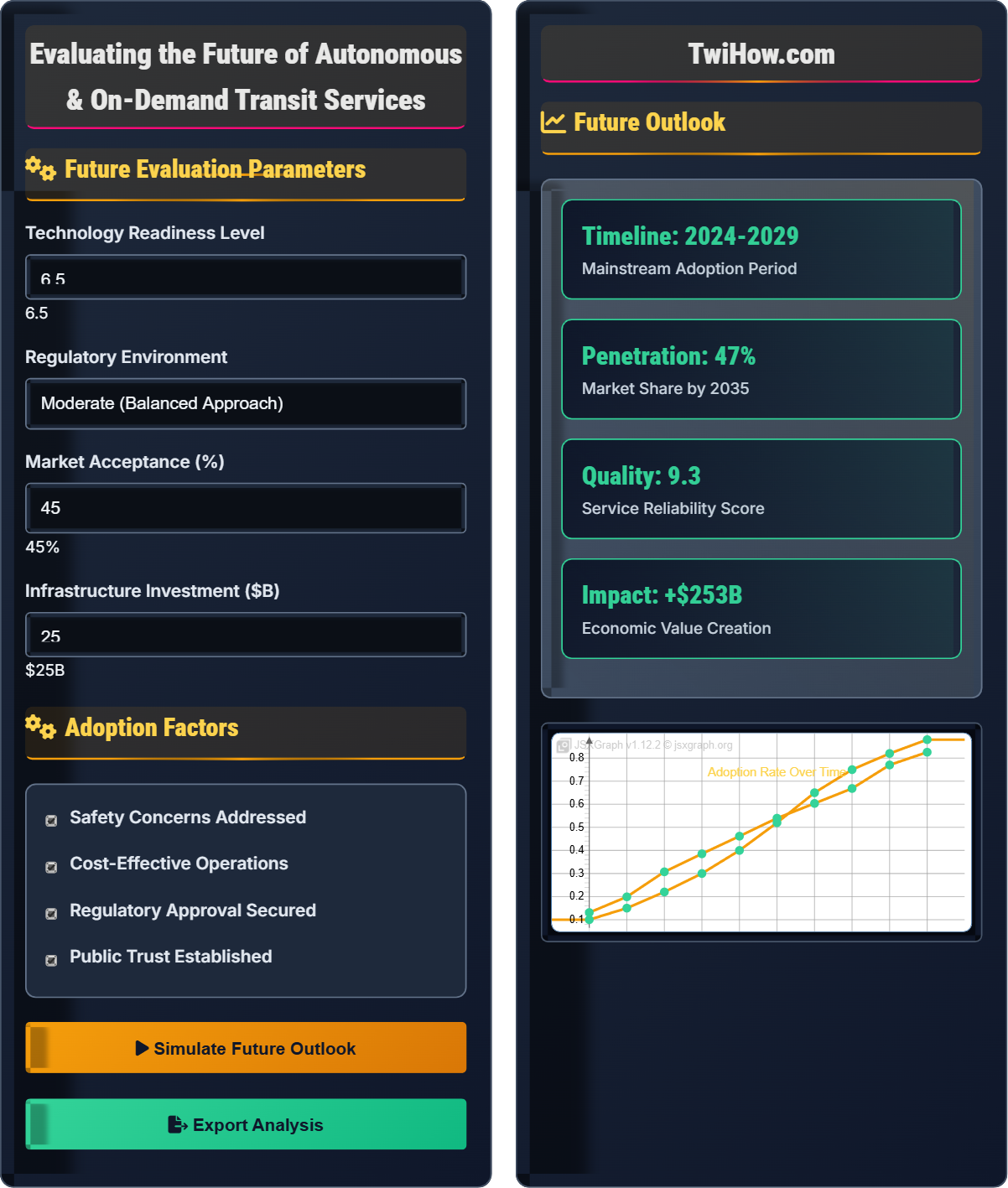
Future Evaluation Parameters
Adoption Factors
Future Outlook
| Year | Adoption Rate | Service Coverage | User Satisfaction |
|---|---|---|---|
| 2026 | 5% | 10% | 7.2 |
| 2028 | 15% | 25% | 7.8 |
| 2030 | 25% | 45% | 8.1 |
| 2035 | 35% | 70% | 8.4 |
Autonomous & On-Demand Transit Future Evaluation
Autonomous and on-demand transit services represent the next evolution in urban mobility, combining self-driving technology with flexible, demand-responsive service models. These systems use AI, sensors, and connectivity to provide personalized transportation without human drivers, adapting to real-time demand and optimizing routes dynamically.
Future evaluation follows a structured approach:
Where:
- Technology Maturity: Development and testing progress
- Market Readiness: Consumer acceptance and demand
- Regulatory Support: Government policies and approvals
- Barriers: Technical, economic, and social obstacles
- Risk Factors: Safety, security, and reliability concerns
- Societal Impact: Benefits to communities and environment
Key areas where autonomous and on-demand transit applies:
- Last-Mile Solutions: Connecting users to major transit hubs
- Paratransit Services: Serving mobility-impaired populations
- Suburban Mobility: Providing service where traditional transit isn't viable
- Freight Delivery: Automated cargo and package transport
- Emergency Response: Rapid deployment for urgent needs
- Tourist Services: Guided tours and sightseeing
- Technology Adoption Curve: Predicting mainstream acceptance
- Diffusion of Innovation: Understanding spread patterns
- Scenario Analysis: Multiple future possibilities
- SWOT Analysis: Strengths, weaknesses, opportunities, threats
- PESTEL Analysis: Political, economic, social, technological factors
- Cost-Benefit Analysis: Economic impact assessment
Fundamentals of Transit Future Evaluation
Autonomous vehicles, on-demand transit, mobility-as-a-service, autonomous buses, ride-sharing, public transit integration, technology adoption, future forecasting.
Adoption Rate = (Technology × Market × Regulation) / (Barriers × Risks)
Where higher values indicate faster adoption potential.
- Technology must mature before mass adoption
- Regulation lags behind technological development
- Public acceptance is crucial for success
Applications
Autonomous shuttles, on-demand buses, ride-hailing integration, paratransit services, freight delivery, airport connections.
- Urban core transportation
- Suburban connectivity
- Paratransit services
- Freight and delivery
- Tourist and recreational
- Technology maturity and reliability
- Regulatory approval processes
- Public acceptance and trust
Autonomous Transit Future Quiz
What is the most significant technical challenge currently facing autonomous transit systems?
Navigation in complex urban environments remains the primary technical challenge. Autonomous vehicles must process countless variables simultaneously: pedestrians, cyclists, other vehicles, road construction, weather conditions, and unexpected obstacles. The unpredictability of urban environments with mixed traffic, complex intersections, and human behavior presents the greatest technological hurdle.
The answer is B) Navigation in complex urban environments with unpredictable elements.
While other factors like battery technology and manufacturing costs are important, navigation represents the core challenge of autonomous driving. The AI must make split-second decisions based on sensor data, predict the actions of other road users, and navigate complex traffic patterns. This requires sophisticated machine learning algorithms and extensive testing in diverse conditions before widespread deployment.
Technology Readiness Level: Measure of technology maturity
Urban Navigation: Autonomous operation in city environments
Sensor Fusion: Combining data from multiple sensors
• Urban environments present the greatest navigation challenges
• Complex decision-making requires extensive testing
• Safety standards must be extremely high
• Focus on navigation capabilities when evaluating readiness
• Consider testing environments and conditions
• Look for real-world deployment experience
• Overestimating current technology capabilities
• Not considering complex urban scenarios
• Focusing only on ideal conditions
Explain the factors that influence public acceptance of autonomous transit services and describe strategies to build trust.
Factors Influencing Acceptance: Safety concerns, trust in technology, previous experiences with automation, perceived benefits, demographic factors, and media portrayal all influence public acceptance of autonomous transit.
Trust-Building Strategies:
1. Transparency: Open communication about safety measures and testing results
2. Gradual Introduction: Start with low-risk environments and expand gradually
3. Education Campaigns: Inform the public about technology and safety features
4. Experience Programs: Offer trial rides to build familiarity
5. Regulatory Oversight: Demonstrate rigorous safety standards and testing
6. Stakeholder Engagement: Involve communities in planning and development
Public acceptance is often the deciding factor in autonomous transit adoption, regardless of technological capability. Trust must be earned through demonstrated safety, transparency, and gradual exposure. The technology itself is only part of the equation - public perception and confidence are equally important. Building trust requires consistent, reliable performance and clear communication about safety measures.
Public Acceptance: Willingness to use autonomous services
Trust Building: Establishing confidence in new technology
Gradual Introduction: Phased deployment strategy
• Safety must be demonstrably superior to human driving
• Transparency builds public confidence
• Gradual introduction reduces resistance
• Start with familiar, low-risk applications
• Provide clear safety statistics
• Engage with community leaders
• Underestimating public skepticism
• Not addressing safety concerns proactively
• Rushing deployment without building trust
A city estimates that autonomous on-demand transit could replace 20% of private vehicle trips and reduce parking demand by 30%. If the city has 1.2 million residents with an average of 1.2 private vehicles per household, and parking spaces cost $30,000 to construct, calculate the potential economic impact of reduced parking demand and describe the broader economic implications.
Calculations:
• Total households: 1,200,000 ÷ 2.5 = 480,000 households
• Total private vehicles: 480,000 × 1.2 = 576,000 vehicles
• Trips replaced: 576,000 × 0.20 = 115,200 vehicles worth of trips
• Parking spaces freed: 115,200 × 0.30 = 34,560 spaces
• Construction cost savings: 34,560 × $30,000 = $1.037 billion
Broad Economic Implications:
• Land value increases from repurposed parking areas
• Reduced infrastructure maintenance costs
• Productivity gains from reduced driving time
• Healthcare savings from reduced accidents
• Job displacement in driving sectors
• New employment in technology and maintenance
Result: The city could save over $1 billion in parking infrastructure costs alone, with additional economic benefits from land repurposing and productivity gains.
This example demonstrates the significant economic implications of autonomous transit adoption. The impact extends beyond direct cost savings to include land use changes, productivity gains, and sectoral employment shifts. Economic modeling must consider both immediate and long-term effects, including positive benefits and potential negative consequences for affected industries.
Economic Impact: Financial consequences of technology adoption
Land Repurposing: Converting parking areas to other uses
Productivity Gains: Economic benefits from time savings
• Consider both positive and negative economic effects
• Include indirect benefits like land value changes
• Account for employment sector shifts
• Model long-term economic effects
• Consider land use transformation potential
• Include productivity and health benefits
• Only counting direct cost savings
• Not considering employment impacts
• Ignoring land use transformation effects
You're evaluating how autonomous on-demand services could integrate with existing public transit. Identify the main integration challenges and propose solutions to create a seamless multimodal transportation network.
Integration Challenges:
1. Technology Compatibility: Different systems, payment platforms, and data standards
2. Service Coordination: Scheduling, routing, and real-time adjustments
3. Fare Integration: Unified payment systems and pricing models
4. Infrastructure Alignment: Stations, stops, and dedicated lanes
5. Regulatory Harmonization: Different oversight and safety standards
Proposed Solutions:
• Develop open API standards for system integration
• Create unified mobility apps for trip planning and payment
• Establish joint planning processes between agencies
• Design transit-oriented autonomous vehicle zones
• Develop consistent safety and operational standards
Integration between autonomous services and existing transit requires coordination across multiple dimensions: technical, operational, financial, and regulatory. The goal is to create a seamless experience where users can transition between different modes without friction. This requires standardized systems, shared data, and coordinated planning that treats all transportation modes as part of a unified network.
Multimodal Integration: Coordinated use of multiple transport modes
Unified Payment: Single payment system for all transit
Open APIs: Standardized system interfaces
• Integration must be planned from the beginning
• Standards should be open and interoperable
• User experience must be seamless
• Establish integration standards early
• Create unified trip planning tools
• Develop common payment systems
• Treating autonomous services as separate from transit
• Not planning for system integration
• Creating incompatible payment systems
Which regulatory challenge is most likely to slow the deployment of autonomous transit services?
Liability and insurance requirements present the most significant regulatory challenge. Determining responsibility when autonomous vehicles are involved in accidents is complex, particularly when traditional insurance models assume human drivers. Regulatory bodies must establish new frameworks for liability, insurance coverage, and safety standards that account for machine decision-making.
The answer is B) Liability and insurance requirements.
Regulatory frameworks must evolve to address fundamental questions about responsibility and risk in autonomous systems. Traditional legal concepts like negligence and liability are based on human behavior, making them inadequate for machine-operated vehicles. Regulators must balance innovation with safety while creating clear rules that enable business development.
Liability Framework: Legal responsibility for damages
Insurance Requirements: Coverage mandates for autonomous vehicles
Safety Standards: Regulatory safety requirements
• Liability frameworks must address machine decision-making
• Insurance models need to adapt to autonomous operation
• Safety standards must be rigorous and clear
• Monitor regulatory developments closely
• Engage with policymakers early
• Develop comprehensive insurance strategies
• Underestimating regulatory complexity
• Not planning for liability requirements
• Assuming existing insurance models apply
FAQ
Q: What regulatory frameworks are needed for autonomous transit deployment?
A: Essential regulatory frameworks include:
Safety Standards: Performance requirements for autonomous systems and vehicles
Testing Protocols: Certification processes for autonomous capabilities
Liability Rules: Clear assignment of responsibility for accidents
Insurance Requirements: Coverage mandates for autonomous operations
Operational Regulations: Rules for deployment in different environments
Data Privacy: Protection of passenger information and location data
Accessibility: ADA compliance for autonomous vehicles
Regulatory approaches must balance innovation with safety while providing clear guidance for industry development.
Q: What are the main technical challenges in autonomous transit development?
A: Main technical challenges include:
Sensor Reliability: Ensuring consistent performance in all weather and lighting conditions
Edge Case Handling: Managing rare but critical scenarios that require human judgment
Real-time Processing: Making split-second decisions with complex sensor data
Mapping Accuracy: Maintaining precise maps for navigation
System Integration: Coordinating multiple subsystems reliably
Cybersecurity: Protecting against hacking and unauthorized access
Fail-Safe Mechanisms: Safe operation when systems malfunction
Addressing these challenges requires continued advancement in AI, sensor technology, and system architecture.