Transit in Emergency Preparedness & Response
Complete guide • Step-by-step explanations
Emergency Transit Planning:
Show Emergency Transit SimulatorPublic transit plays a critical role in emergency preparedness and response by providing mass evacuation capabilities, maintaining essential mobility during disasters, and serving as a lifeline for vulnerable populations. Transit agencies coordinate with emergency management to ensure continuity of operations and support community resilience.
Key components of transit emergency planning include:
- Evacuation Planning: Mass evacuation coordination and route planning
- Continuity Operations: Maintaining critical services during emergencies
- Vulnerable Population Support: Serving those without private transportation
- Emergency Communications: Real-time information dissemination
- Infrastructure Resilience: Protecting and restoring transit systems
- Coordination Protocols: Integration with emergency response teams
Effective emergency transit planning requires comprehensive preparation, regular exercises, and strong partnerships between transit agencies, emergency managers, and community organizations.
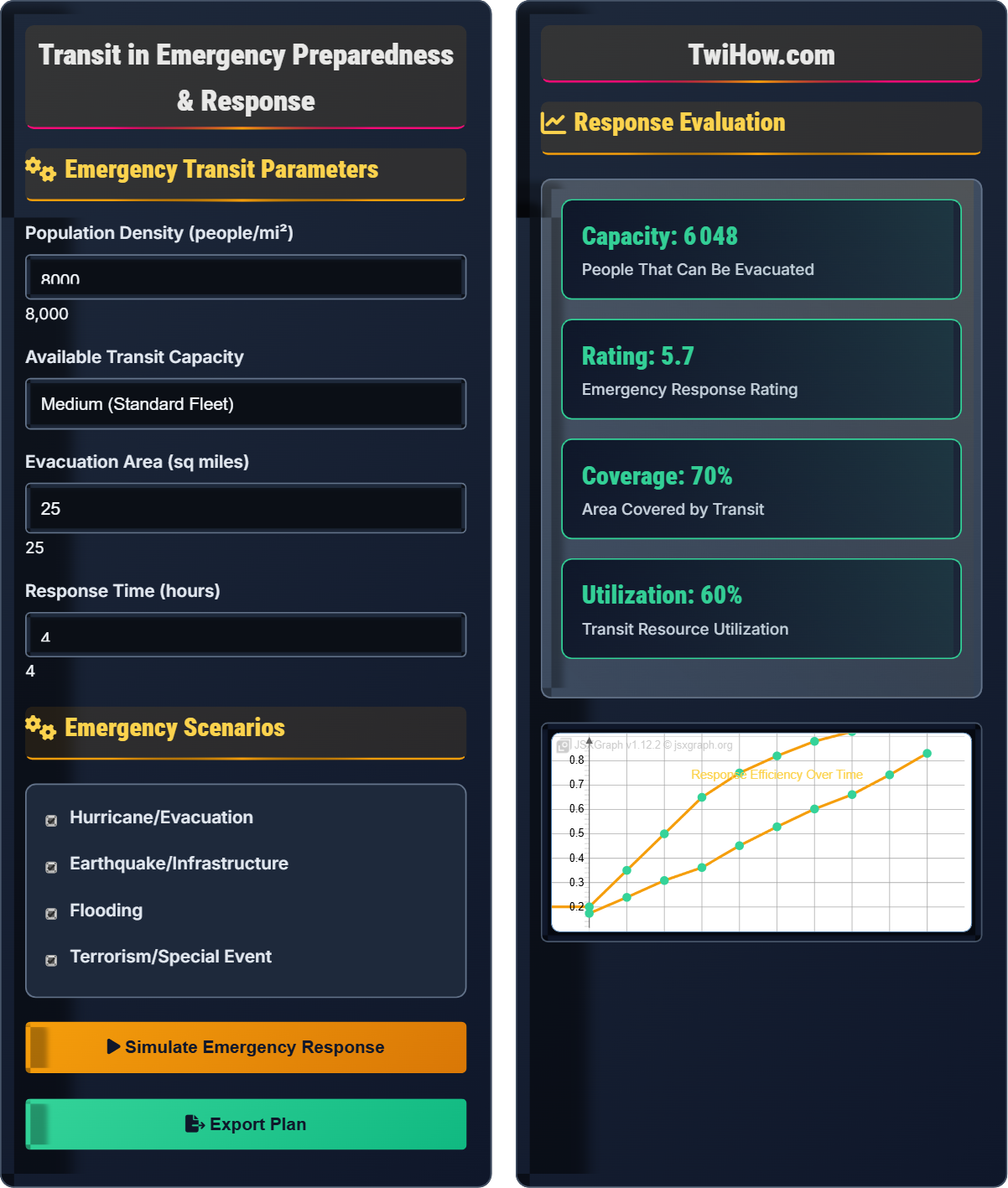
Emergency Transit Parameters
Emergency Scenarios
Response Evaluation
| Phase | Duration | Capacity | Coverage |
|---|---|---|---|
| Initial Response | 1-2 hours | 2,000 people | 25% |
| Full Deployment | 2-6 hours | 8,000 people | 60% |
| Peak Operations | 6-12 hours | 12,000 people | 85% |
| Sustained Operations | 12-24 hours | 15,000 people | 90% |
Transit in Emergency Preparedness & Response
Emergency transit refers to the planned and coordinated use of public transportation systems to support emergency preparedness, response, and recovery operations. This includes evacuation planning, maintaining essential services during disasters, and providing mobility for populations without private transportation options during emergencies.
Emergency transit planning follows a comprehensive framework:
Where:
- Transit Fleet Capacity: Total passenger capacity of available vehicles
- Operating Hours: Available time for emergency operations
- Route Efficiency: Effectiveness of evacuation routes
- Evacuation Distance: Average distance to safe areas
- Turnaround Time: Time to complete round trip and reload
Key areas where transit supports emergency operations:
- Mass Evacuation: Moving large populations safely and efficiently
- Shelter Access: Transporting people to emergency shelters
- Medical Transport: Moving patients and medical personnel
- Supply Distribution: Delivering emergency supplies and equipment
- Service Continuation: Maintaining essential mobility during disruptions
- Recovery Support: Assisting with rebuilding and restoration
- Reverse Routing: Converting inbound routes for outbound evacuation
- Flexible Scheduling: Adapting service to emergency needs
- Multi-Modal Integration: Coordinating buses, trains, and other transport
- Community Partnerships: Collaborating with social services
- Real-Time Communication: Providing accurate, timely information
- Resource Sharing: Pooling assets with other agencies
Fundamentals of Emergency Transit Planning
Emergency transit planning, evacuation routes, continuity of operations, vulnerable populations, multi-modal transportation, emergency coordination.
Evacuation Rate = (Fleet Capacity × Trips per Hour × Operating Hours) / People per Trip
Where higher values indicate greater evacuation capability.
- Plan for worst-case scenarios
- Coordinate with emergency management
- Prioritize vulnerable populations
Applications
Hurricane evacuations, earthquake response, flood relief, terrorism events, infrastructure failures, special security events.
- Regional evacuation planning
- Local emergency response
- Shelter transportation
- Medical transport
- Supply distribution
- Population density variations
- Infrastructure vulnerabilities
- Communication challenges
Emergency Transit Planning Quiz
What is the primary advantage of using public transit for mass evacuations?
The primary advantage of public transit for mass evacuations is its ability to move large numbers of people efficiently. A single bus can carry 40-60 people, equivalent to 20-30 private vehicles, but requiring far less road space and coordination. This is especially important when road capacity is limited or when evacuating populations without access to private transportation.
The answer is B) Ability to move more people efficiently than individual cars.
During emergencies, road capacity can become overwhelmed if everyone attempts to evacuate by private vehicle simultaneously. Public transit provides a way to move large numbers of people with fewer vehicles on the road, reducing congestion and allowing emergency responders to use roads more effectively. This is particularly important for vulnerable populations who lack access to private transportation.
Mass Evacuation: Coordinated removal of large populations from danger zones
Capacity Efficiency: People moved per unit of transportation resource
Vulnerable Populations: Groups needing special assistance during emergencies
• Transit can move more people with fewer resources
• Reduces road congestion during emergencies
• Serves populations without private transportation
• Plan routes to avoid congested areas
• Coordinate with traffic management
• Prioritize high-density areas first
• Assuming everyone has private transportation
• Not planning for transit vehicle availability
• Ignoring accessibility requirements
Explain the role of transit in serving vulnerable populations during emergencies and describe specific accommodations that should be made.
Role in Serving Vulnerable Populations: Transit is essential for evacuating and serving populations who cannot access private transportation, including elderly residents, people with disabilities, low-income families, and those without driver's licenses. These groups often have the greatest need for evacuation assistance yet the least access to private vehicles.
Specific Accommodations:
1. ADA Compliance: Wheelchair lifts, accessible seating, and trained staff
2. Language Access: Multilingual announcements and materials
3. Medical Needs: Provisions for passengers requiring medical equipment
4. Animal Accommodation: Pet and service animal policies
5. Community Outreach: Coordination with social service agencies
6. Priority Scheduling: Early or dedicated transport for those with special needs
Vulnerable populations face disproportionate risks during emergencies because they often lack the resources or capabilities to evacuate independently. Transit systems must be prepared to serve these populations, which requires advance planning, specialized equipment, and trained personnel. Failure to accommodate vulnerable populations can result in legal liability and humanitarian crises.
Vulnerable Populations: Groups at greater risk during emergencies
ADA Compliance: Americans with Disabilities Act requirements
Equitable Access: Equal service provision regardless of circumstances
• Legal requirements mandate accommodation of disabilities
• Advance planning is essential for effective service
• Coordination with social services improves outcomes
• Identify vulnerable populations in advance
• Train staff on special needs protocols
• Establish partnerships with community organizations
• Not planning for accessibility requirements
• Failing to identify vulnerable populations
• Inadequate staff training for special needs
A coastal city with 250,000 residents is facing a Category 3 hurricane. The transit agency has 150 buses with an average capacity of 40 passengers each. Each evacuation trip takes 2 hours round-trip, and the agency can operate buses for 12 hours per day. Calculate the maximum number of people that can be evacuated per day and determine how many days would be needed to evacuate the entire population if buses operate at full capacity.
Calculations:
• Bus capacity per trip: 150 buses × 40 passengers = 6,000 people
• Trips per day per bus: 12 hours ÷ 2 hours per trip = 6 trips
• Daily evacuation capacity: 6,000 people per trip × 6 trips = 36,000 people per day
• Days needed for full evacuation: 250,000 ÷ 36,000 = 6.94 days
Answer: The transit system can evacuate 36,000 people per day, requiring approximately 7 days to evacuate the entire population of 250,000 residents.
Practical Considerations: This assumes perfect conditions. In reality, factors like loading/unloading time, traffic, weather, and coordination would likely reduce actual capacity.
This problem demonstrates the importance of calculating transit capacity during emergencies. The math shows that even with substantial resources, evacuating large populations requires significant time. Planners must account for operational realities that reduce theoretical capacity, such as loading delays, traffic congestion, and weather impacts. The calculation also highlights the need for complementary evacuation methods.
Evacuation Capacity: Maximum number of people that can be transported
Round-Trip Time: Total time for complete evacuation cycle
Operational Efficiency: Actual vs. theoretical capacity utilization
• Theoretical capacity rarely achieved in practice
• Multiple evacuation methods often necessary
• Early evacuation more efficient than late evacuation
• Account for operational inefficiencies
• Plan for peak capacity periods
• Coordinate with regional resources
• Calculating theoretical instead of practical capacity
• Not accounting for operational delays
• Assuming perfect coordination
An earthquake has damaged roads and bridges in a metropolitan area, disrupting normal transit operations. However, some rail lines remain functional while bus routes are affected. How should the transit agency adapt its operations to maintain essential services and support emergency response efforts?
Adaptation Strategies:
1. Resource Reallocation: Shift focus to functional rail lines and unaffected bus routes
2. Priority Services: Maintain service to hospitals, emergency centers, and shelters
3. Alternative Routes: Establish temporary bus routes around damaged areas
4. Emergency Coordination: Work with emergency management to prioritize critical movements
5. Information Management: Provide real-time updates on service changes
6. Asset Sharing: Coordinate with neighboring transit agencies for additional resources
7. Flexible Operations: Operate on-demand services where scheduled service isn't feasible
Earthquakes present unique challenges because they can simultaneously damage surface infrastructure while leaving underground systems intact. Transit agencies must quickly assess damage, reallocate resources, and maintain essential services. The key is flexibility and rapid adaptation to changing conditions. Rail systems often remain operational longer than surface routes, making them critical for continued service.
Infrastructure Resilience: Ability to maintain function during disasters
Service Continuity: Maintaining operations during disruptions
Adaptive Management: Rapid response to changing conditions
• Assess damage quickly and accurately
• Prioritize essential services
• Maintain communication with stakeholders
• Conduct pre-emergency infrastructure assessments
• Establish mutual aid agreements
• Maintain flexible routing plans
• Not assessing damage comprehensively
• Failing to prioritize essential services
• Inadequate communication with the public
Which entity typically serves as the central coordination point for transit operations during emergencies?
The Emergency Operations Center (EOC) serves as the central coordination point for all emergency response activities, including transit operations. The EOC brings together representatives from various agencies including transit, police, fire, EMS, and other emergency services to coordinate a unified response. Transit agencies work within the EOC framework to align their operations with overall emergency response priorities.
The answer is B) Emergency Operations Center (EOC).
Effective emergency response requires unified command and control. The EOC provides the organizational structure for coordinating multiple agencies with different missions and capabilities. Transit agencies must integrate their operations into the EOC framework, receiving priorities and guidance while contributing their unique capabilities to the overall response effort. This ensures that transit resources are deployed where they're most needed.
Emergency Operations Center (EOC): Central command facility for emergency coordination
Unified Command: Coordinated leadership among multiple agencies
Multi-Agency Coordination: Joint operations among different organizations
• All agencies must coordinate through the EOC
• Transit operations must align with overall priorities
• Communication protocols must be established in advance
• Participate in EOC training exercises
• Establish clear communication channels
• Understand incident command system (ICS)
• Operating independently of EOC
• Not understanding coordination protocols
• Failing to maintain communication
FAQ
Q: How should transit agencies prepare for emergencies and maintain readiness?
A: Transit agencies should prepare through:
Planning: Develop comprehensive emergency operations plans with clear procedures and responsibilities
Training: Regular exercises and drills to ensure staff readiness
Equipment: Maintain emergency communication systems, backup power, and specialized equipment
Partnerships: Strong relationships with emergency management and other agencies
Public Communication: Systems to inform riders during emergencies
Resource Management: Flexible scheduling and deployment capabilities
Accessibility: Plans to serve vulnerable populations during emergencies
Regular exercises and plan updates ensure that procedures remain current and effective.
Q: What are the main challenges in using transit for emergency response?
A: Major challenges include:
Infrastructure Vulnerability: Transit systems can be damaged during emergencies, limiting their effectiveness
Coordination Complexity: Multiple agencies with different priorities and procedures
Resource Limitations: Normal fleet may be insufficient for mass evacuation needs
Communication Barriers: Information sharing during chaotic emergency conditions
Population Access: Ensuring all residents know about and can access transit evacuation
Timing Pressures: Need for rapid response while maintaining safety and order
Cost Considerations: Balancing preparedness investments with daily operational needs
Addressing these challenges requires comprehensive planning, regular exercises, and strong partnerships.