Transit Governance & Regional Coordination
Complete guide • Step-by-step explanations
Transit Governance & Coordination:
Show Governance SimulatorTransit governance and regional coordination involve the complex organizational structures, funding mechanisms, and collaborative processes that enable multiple agencies to work together effectively. This includes establishing clear roles, shared decision-making processes, and integrated service delivery across jurisdictional boundaries.
Key governance considerations include:
- Organizational Structure: Authority, accountability, and decision-making frameworks
- Funding Coordination: Shared resources and revenue allocation
- Service Integration: Seamless passenger experience across agencies
- Policy Alignment: Consistent fare structures and service standards
- Planning Coordination: Unified regional transportation planning
- Performance Metrics: Shared goals and accountability measures
Successful regional coordination requires strong institutional frameworks, effective communication, and alignment of interests among diverse stakeholders with varying priorities and constituencies.
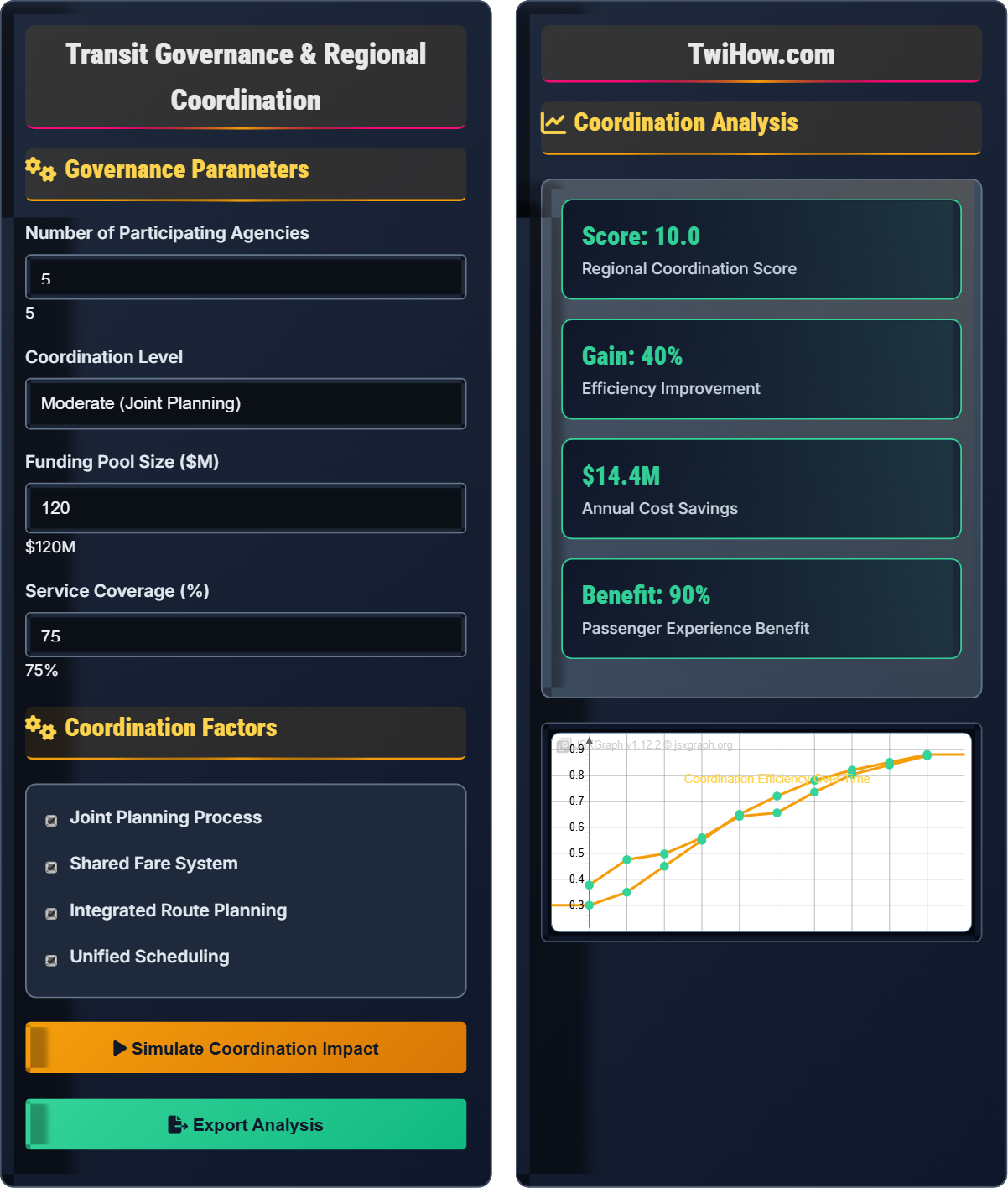
Governance Parameters
Coordination Factors
Coordination Analysis
| Factor | Current | Target | Gap |
|---|---|---|---|
| Service Integration | 60% | 85% | 25% |
| Fare Coordination | 45% | 90% | 45% |
| Planning Alignment | 50% | 80% | 30% |
| Performance Metrics | 35% | 75% | 40% |
Transit Governance & Regional Coordination
Transit governance refers to the organizational structures, decision-making processes, and institutional arrangements that define how public transportation systems are planned, funded, operated, and regulated. Regional coordination involves the collaborative mechanisms that enable multiple agencies to work together across jurisdictional boundaries to provide seamless transportation services.
Effective transit governance follows a structured framework:
Where:
- Service Integration: Degree of seamless service across agencies
- Funding Coordination: Alignment of financial resources and priorities
- Policy Alignment: Consistency of fare, service, and operational policies
- Agency Complexity: Number and diversity of participating agencies
- Jurisdictional Barriers: Political and administrative obstacles
Key areas where regional coordination applies:
- Regional Planning: Coordinated long-range transportation plans
- Service Integration: Seamless transfers and consistent standards
- Funding Allocation: Shared resources and equitable distribution
- Performance Monitoring: Unified metrics and reporting
- Technology Integration: Common payment and information systems
- Emergency Response: Coordinated emergency transportation
- Single Authority: One agency governs all transit in region
- Regional Council: Multi-agency governance body
- Joint Powers Authority: Legal entity formed by multiple agencies
- Memorandum of Understanding: Contractual coordination agreements
- Metropolitan Planning Organization: Regional planning coordination
- Consortium Model: Cooperative arrangement among agencies
Fundamentals of Transit Governance
Regional coordination, inter-agency cooperation, governance structures, funding mechanisms, service integration, metropolitan planning, performance metrics.
Coordination Score = (Integration × Cooperation × Alignment) / (Complexity × Barriers)
Where higher values indicate better coordination effectiveness.
- Alignment of incentives is crucial for success
- Clear governance structures prevent conflicts
- Regular communication maintains momentum
Applications
Regional transit authorities, joint fare systems, coordinated planning, shared funding, unified operations, emergency response.
- Regional transportation planning
- Service integration
- Funding coordination
- Technology systems
- Performance management
- Political jurisdictions and boundaries
- Legal frameworks and authorities
- Funding sources and allocation
Transit Governance Quiz
Which governance model provides the strongest authority for regional coordination?
A Joint Powers Authority (JPA) provides the strongest authority for regional coordination because it creates a legally binding entity with its own governance structure, budget, and operational authority. Unlike contractual agreements or informal councils, an JPA has legal standing and can make binding decisions that all participating agencies must follow.
The answer is B) Joint Powers Authority.
The strength of governance models varies based on their legal authority and operational independence. Contractual arrangements like MOUs rely on continued political support and can be dissolved more easily. Formal legal entities like JPAs provide more stability and authority, making them better suited for long-term coordination efforts that require binding decisions.
Joint Powers Authority (JPA): Legal entity formed by multiple agencies
Memorandum of Understanding (MOU): Contractual agreement between agencies
Governance Authority: Power to make binding decisions
• Legal authority determines governance effectiveness
• Binding agreements provide more stability than informal ones
• Governance structure must match coordination needs
• Choose governance model based on coordination intensity needed
• Consider legal and political constraints
• Ensure all stakeholders have appropriate representation
• Underestimating the need for legal authority
• Choosing model that doesn't match coordination goals
• Not considering political feasibility
Explain the challenges of coordinating funding among multiple transit agencies and describe strategies to overcome these challenges.
Challenges in Funding Coordination:
1. Different Revenue Sources: Agencies may have different funding streams (local, state, federal) with varying restrictions
2. Competing Priorities: Each agency has its own capital and operational needs
3. Political Considerations: Elected officials may prioritize their constituents' needs
4. Accountability Requirements: Different reporting and compliance standards
Strategies to Overcome:
1. Regional Pooled Funds: Create shared funding pools for regional priorities
2. Formula-Based Allocation: Use objective criteria for fund distribution
3. Joint Grant Applications: Pursue federal funding as unified region
4. Performance-Based Funding: Link funds to regional performance outcomes
Funding coordination is often the most challenging aspect of regional transit governance because it directly affects each agency's ability to serve its local constituency. Agencies must balance their local obligations with regional needs. Successful coordination requires creating incentives that align local and regional interests, often through shared funding mechanisms that reward cooperation.
Funding Coordination: Aligning financial resources across agencies
Revenue Diversification: Multiple funding sources for stability
Performance-Based Funding: Allocation tied to outcomes
• Funding must be aligned with service priorities
• Transparency in allocation processes builds trust
• Shared funding creates shared accountability
• Establish clear funding criteria and processes
• Create regional priority rankings
• Develop performance metrics for fund allocation
• Not addressing political concerns upfront
• Failing to establish clear allocation criteria
• Ignoring local agency funding autonomy
A metropolitan area has 4 separate transit agencies serving different jurisdictions. Currently, passengers must pay separate fares and navigate different systems when traveling across agency boundaries. The region wants to implement a unified fare system. Calculate the potential benefits in terms of passenger convenience and cost savings, assuming 100,000 daily cross-boundary trips currently requiring multiple tickets at $4 each, with a projected 25% increase in cross-boundary ridership after integration.
Current Situation:
• 100,000 daily cross-boundary trips
• Average cost per trip: $4 per agency × 2 agencies = $8
• Total daily cost: 100,000 × $8 = $800,000
After Integration:
• Ridership increase: 100,000 × 1.25 = 125,000 trips
• New cost per trip: $5 (integrated fare)
• Total daily revenue: 125,000 × $5 = $625,000
• Passenger savings: ($8 - $5) × 125,000 = $375,000 daily
• Annual savings: $375,000 × 365 = $136.875M
Additional Benefits: Increased ridership, reduced administrative costs, improved service perception.
This example demonstrates the economic rationale for service integration. While the total revenue might decrease initially, the benefits include increased ridership, reduced administrative costs, and significant passenger savings. The convenience factor alone can justify the investment in integration systems. This type of analysis helps justify the costs of coordination efforts.
Cross-Boundary Travel: Trips spanning multiple agency jurisdictions
Integrated Fare System: Single payment system across agenciesRidership Elasticity: Response of ridership to service changes
• Integration benefits compound over time
• Passenger convenience drives ridership
• Administrative savings offset implementation costs
• Quantify passenger benefits to justify investment
• Plan for increased ridership after integration
• Consider phased implementation approaches
• Underestimating passenger response to convenience
• Not accounting for increased ridership
• Focusing only on revenue impacts
You are tasked with creating a regional transit coordination body, but the member agencies operate in different counties with competing political interests. How would you structure the governance to ensure fair representation while maintaining effective decision-making?
Governance Structure:
1. Representative Board: Seats allocated based on population served, ridership, or service area size
2. Committee Structure: Technical committees for operational matters, policy committees for strategic decisions
3. Executive Committee: Rotating chairmanship to ensure balanced leadership
4. Conflict Resolution: Mediation process for disputes between agencies
5. Transparency Measures: Public meetings, published minutes, and stakeholder input processes
Decision-Making: Majority vote for routine matters, supermajority for significant policy changes, consensus for controversial issues.
Political coordination requires balancing representation with effectiveness. Pure equality may not reflect service disparities, while pure proportional representation may marginalize smaller agencies. The key is creating structures that acknowledge political realities while enabling effective governance. Clear processes and transparency help build trust among stakeholders with competing interests.
Representative Governance: Decision-making reflecting stakeholder interests
Supermajority: Voting threshold above simple majority
Stakeholder Representation: Inclusion of all affected parties
• Representation must reflect actual service impacts
• Decision-making processes must be clearly defined
• Conflict resolution mechanisms prevent deadlocks
• Use objective criteria for representation
• Establish clear decision-making thresholds
• Include sunset clauses for periodic review
• Not addressing political concerns in design
• Creating overly complex decision-making processes
• Failing to include conflict resolution mechanisms
Which type of performance metric is most effective for measuring regional transit coordination success?
Regional system-wide performance measures are most effective for measuring coordination success because they capture the benefits of integrated operations across agencies. These metrics include regional ridership, average trip time, fare integration success, and cross-boundary journey completion rates. Individual agency metrics don't reflect the synergies created through coordination.
The answer is B) Regional system-wide performance measures.
Measuring coordination success requires looking at outcomes that span agency boundaries. Individual agency metrics may not capture the benefits of coordination, such as increased regional ridership due to better connectivity or reduced travel times through integrated scheduling. System-wide metrics align incentives for cooperation and provide accountability for coordination investments.
System-Wide Metrics: Measures spanning multiple agencies
Coordination Outcomes: Benefits resulting from joint operations
Performance Accountability: Measuring results against goals
• Metrics must reflect coordination benefits
• Shared metrics create common accountability
• Regional measures capture system synergies
• Include both operational and customer-focused metrics
• Establish baseline measurements before coordination
• Report metrics jointly to demonstrate success
• Using only individual agency metrics
• Not establishing baseline measurements
• Failing to link metrics to coordination goals
FAQ
Q: What are the keys to successful regional transit coordination?
A: Keys to success include:
Strong Leadership: Dedicated champions who can navigate political complexities
Clear Vision: Shared understanding of regional goals and benefits
Appropriate Structure: Governance that matches coordination needs
Aligned Incentives: Mechanisms that reward cooperation
Resource Commitment: Adequate funding for coordination activities
Regular Communication: Ongoing dialogue among stakeholders
Measurable Outcomes: Clear metrics to track progress
Success requires sustained commitment from all participants and recognition that coordination is an ongoing process, not a one-time event.
Q: What are the main challenges in implementing regional transit coordination?
A: Main challenges include:
Political Jurisdictions: Different elected officials with local priorities
Organizational Culture: Agencies accustomed to independent operations
Funding Constraints: Competition for limited resources
Legal Barriers: Statutory limitations on inter-agency cooperation
Technical Integration: Connecting different systems and technologies
Performance Measurement: Difficulties in tracking shared outcomes
Change Management: Resistance to new processes and structures
Overcoming these challenges requires careful planning, stakeholder engagement, and phased implementation approaches.