Emerging Trends in Urban Mobility & Public Transit for 2026
Complete guide • Step-by-step explanations
2026 Transit Trends:
Show Trend SimulatorThe urban mobility landscape in 2026 will be characterized by unprecedented technological integration, sustainability imperatives, and evolving user expectations. Cities worldwide are implementing smart transit solutions, expanding electrification, and embracing Mobility as a Service (MaaS) platforms to create more efficient, sustainable, and user-centric transportation networks.
Key emerging trends for 2026 include:
- Smart Transit Integration: AI-powered routing and predictive maintenance
- Electrification Acceleration: Full electric fleets and charging infrastructure
- Mobility as a Service: Unified platforms for all transportation modes
- Micro-Mobility Expansion: E-bikes, scooters, and dockless systems
- Autonomous Integration: Self-driving shuttles and bus rapid transit
- Hyperlocal Transit: On-demand services for first/last mile connections
These trends reflect a fundamental shift toward sustainable, technology-enabled, and user-centered urban transportation systems that prioritize efficiency, accessibility, and environmental responsibility.
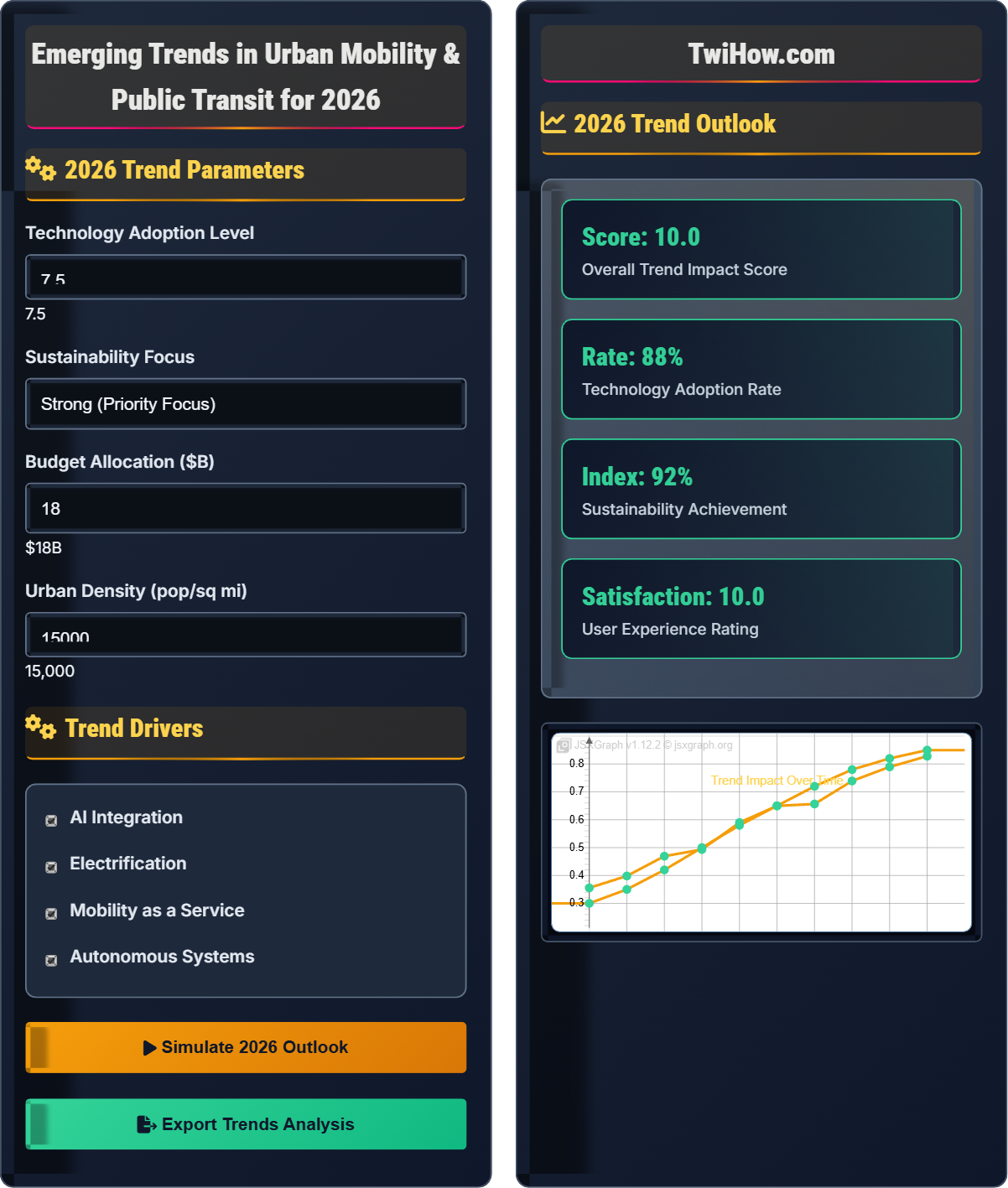
2026 Trend Parameters
Trend Drivers
2026 Trend Outlook
| Trend | 2024 | 2025 | 2026 | Impact Level |
|---|---|---|---|---|
| Smart Transit | 45% | 58% | 72% | High |
| Electrification | 35% | 52% | 68% | Very High |
| MaaS Platforms | 25% | 40% | 55% | High |
| Micro-Mobility | 40% | 55% | 70% | Medium |
Emerging Trends in Urban Mobility & Public Transit for 2026
The urban mobility landscape for 2026 represents a convergence of technological advancement, environmental consciousness, and evolving user expectations. Cities worldwide are implementing smart transit solutions, expanding electrification, and embracing Mobility as a Service (MaaS) platforms to create more efficient, sustainable, and user-centric transportation networks.
Trend impact follows a structured approach:
Where:
- Technology Maturity: Development and testing progress
- Market Demand: Consumer and institutional interest
- Regulatory Support: Government policies and incentives
- Implementation Barriers: Technical, economic, and social obstacles
- Cost Factors: Financial requirements and returns
- User Adoption: Public acceptance and usage rates
Key areas where 2026 trends apply:
- Smart Transit: AI-powered routing and predictive maintenance
- Electrification: Electric buses and charging infrastructure
- Mobility as a Service: Unified transportation platforms
- Micro-Mobility: E-bikes, scooters, and dockless systems
- Autonomous Integration: Self-driving shuttle services
- Hyperlocal Transit: On-demand first/last mile solutions
- Technology-Driven: AI, IoT, and data analytics integration
- Sustainability-Focused: Zero-emission vehicles and renewable energy
- User-Centric: Personalized, on-demand services
- System-Integrated: Seamless multimodal connectivity
- Efficiency-Oriented: Optimized routing and resource allocation
- Accessibility-Enhanced: Universal design and inclusive services
Fundamentals of 2026 Transit Trends
Smart transit, electrification, mobility as a service, micro-mobility, autonomous systems, user experience, sustainability, technology integration.
Trend Score = (Technology × Adoption × Sustainability) / (Barriers × Costs)
Where higher values indicate stronger trend impact.
- Technology must solve real user problems
- Sustainability is increasingly critical
- User experience drives adoption
Applications
Smart bus systems, electric transit fleets, unified mobility apps, autonomous shuttles, micro-mobility integration, hyperlocal services.
- Urban core transportation
- Suburban connectivity
- First/last mile solutions
- Paratransit services
- Freight and delivery
- Technology maturity and reliability
- Regulatory approval processes
- Public acceptance and trust
2026 Transit Trends Quiz
What is the primary benefit of AI-powered smart transit systems in 2026?
AI-powered smart transit systems primarily benefit from predictive maintenance and optimized routing. These systems analyze vast amounts of data to predict when vehicles need maintenance before failures occur, reducing downtime and improving reliability. They also optimize routes in real-time based on traffic, demand, and other factors.
The answer is B) Predictive maintenance and optimized routing.
Smart transit leverages data analytics and AI to make transit systems more efficient and reliable. Rather than just making vehicles faster, the focus is on system optimization - predicting needs, preventing problems, and adapting to changing conditions. This creates more reliable service for passengers and better resource utilization for operators.
Predictive Maintenance: Using data to anticipate equipment needs
Optimized Routing: Real-time route adjustments for efficiency
Smart Transit: Technology-enhanced public transportation
• Data analytics drives system efficiency
• Preventive maintenance reduces operational costs
• Real-time optimization improves service
• Focus on system-wide optimization over individual metrics
• Use predictive analytics for maintenance scheduling
• Implement real-time route adjustments
• Confusing speed with efficiency
• Not utilizing predictive analytics
• Focusing only on hardware upgrades
Explain the environmental and economic impacts of transit electrification trends for 2026.
Environmental Impacts: Transit electrification significantly reduces greenhouse gas emissions, air pollution, and noise pollution. Electric buses and trains produce zero direct emissions and can be powered by renewable energy sources.
Economic Impacts:
1. Operational Savings: Lower fuel and maintenance costs over vehicle lifetime
2. Infrastructure Investment: Significant upfront costs for charging infrastructure
3. Job Creation: New positions in manufacturing and maintenance
4. Energy Security: Reduced dependence on fossil fuel imports
5. Health Benefits: Reduced healthcare costs from cleaner air
2026 Outlook: The balance of investment and savings favors electrification by 2026.
Electrification represents a paradigm shift from operating expense (fuel) to capital expense (vehicles and infrastructure). While initial costs are high, operational savings accumulate over time. The environmental benefits compound, creating additional economic value through improved public health and climate impact reduction.
Transit Electrification: Conversion to electric-powered vehicles
Zero Emissions: No direct pollutant output during operation
Operational vs. Capital Expenses: Recurring vs. upfront costs
• Long-term economics favor electrification
• Environmental benefits compound over time
• Infrastructure planning is critical
• Plan charging infrastructure strategically
• Consider renewable energy integration
• Account for total cost of ownership
• Focusing only on upfront costs
• Not planning charging infrastructure
• Ignoring environmental co-benefits
A city implements a Mobility as a Service (MaaS) platform that integrates bus, rail, bike-share, and ride-hailing services. If the platform reduces average trip planning time from 15 minutes to 3 minutes and increases mode switching by 40%, calculate the potential time savings and describe the broader impacts on urban mobility by 2026.
Time Savings Calculation:
• Time saved per trip: 15 - 3 = 12 minutes
• Mode switching increase: 40%
• If 100,000 daily trips: 12 minutes × 100,000 = 1.2 million minutes saved daily
• Annual savings: 1.2M × 365 = 438 million minutes ≈ 832 years of time saved
Broad Impacts by 2026:
• Increased multimodal transit usage
• Reduced private vehicle dependency
• Improved accessibility for diverse populations
• Enhanced system efficiency through data integration
• Greater user satisfaction and retention
Result: The MaaS platform creates significant time savings while transforming mobility behavior and system efficiency.
This example demonstrates how digital integration can create substantial efficiency gains. The time saved through simplified planning translates into productivity gains for users and operational improvements for the system. MaaS platforms enable users to optimize their transportation choices dynamically, leading to better utilization of existing infrastructure and reduced need for private vehicle ownership.
Mobility as a Service (MaaS): Unified transportation platform
Mode Switching: Changing between different transport types
Total Cost of Ownership: All costs over vehicle lifetime
• Digital integration creates efficiency gains
• Time savings compound across users
• System optimization improves overall performance
• Focus on user experience simplification
• Integrate multiple payment systems
• Provide real-time information
• Not considering user interface simplicity
• Failing to integrate payment systems
• Ignoring data privacy concerns
How will micro-mobility trends reshape urban transit networks by 2026, and what infrastructure changes will be needed to support this integration?
Network Reshaping:
1. First/Last Mile Solutions: Connecting transit stations to destinations
2. Flexible Routing: On-demand services for low-density areas
3. Complementary Services: Supporting traditional transit
4. Reduced Parking Demand: Fewer private vehicles needed
Infrastructure Changes Needed:
• Protected bike lanes and e-scooter paths
• Charging stations at transit hubs
• Secure parking and docking areas
• Integration with transit payment systems
• Smart traffic signals for micro-mobility
• Weather-protected boarding areas
Micro-mobility fills critical gaps in traditional transit networks, particularly for short-distance trips and first/last-mile connections. Rather than replacing transit, it enhances the overall system by making it more accessible and convenient. This requires thoughtful infrastructure planning to ensure safe and efficient integration with existing transportation modes.
Micro-Mobility: Small, lightweight transportation modes
First/Last Mile: Connection between transit and destination
Complementary Services: Supporting rather than competing
• Integration enhances rather than replaces transit
• Safety infrastructure is essential
• Payment integration improves user experience
• Plan for safe integration with existing traffic
• Create dedicated infrastructure where possible
• Implement unified payment systems
• Not providing dedicated infrastructure
• Failing to integrate with transit systems
• Ignoring safety concerns
Which autonomous transit application is most likely to be widely deployed by 2026?
Self-driving urban bus rapid transit is most likely to be widely deployed by 2026. BRT systems operate in controlled environments with dedicated lanes, making autonomous operation more feasible. The predictable routes and controlled infrastructure reduce complexity compared to mixed traffic scenarios.
The answer is B) Self-driving urban bus rapid transit.
Autonomous deployment follows a "controlled to complex" pattern. BRT systems provide the ideal environment for autonomous vehicles: dedicated lanes, predictable routes, controlled intersections, and scheduled operations. This reduces the technological and regulatory challenges compared to mixed traffic environments, making BRT the most likely candidate for widespread autonomous deployment by 2026.
Bus Rapid Transit (BRT): Dedicated bus lanes and stations
Controlled Environment: Predictable, managed operating conditionsAutonomous Deployment: Phased introduction of self-driving vehicles
• Controlled environments enable earlier deployment
• Predictable routes reduce complexity
• Regulatory approval is essential for safety
• Start with controlled, predictable environments
• Focus on dedicated infrastructure
• Plan for gradual capability expansion
• Expecting full autonomy in complex environments
• Not considering infrastructure requirements
• Underestimating regulatory challenges
FAQ
Q: How will these 2026 trends affect transit equity and accessibility?
A: The 2026 trends will have mixed effects on equity:
Positive Impacts: MaaS platforms can improve accessibility by providing unified, affordable options. Micro-mobility can serve areas with limited traditional transit. Smart systems can optimize service in underserved areas.
Challenges: Technology adoption may exclude some populations. Initial costs may limit access. Digital divide could create barriers for certain users.
Mitigation Strategies: Universal design principles, subsidized access programs, digital literacy support, and inclusive planning processes.
Successful implementation requires deliberate focus on equitable access and affordability.
Q: What are the main technical challenges in implementing these 2026 trends?
A: Key technical challenges include:
Data Integration: Connecting diverse systems and data sources seamlessly
Cybersecurity: Protecting connected transit systems from attacks
Interoperability: Ensuring different vendors' systems work together
Scalability: Supporting millions of users and transactions
Reliability: Maintaining system performance under all conditions
Real-time Processing: Handling massive data streams for optimization
Power Infrastructure: Supporting electrification demands
Addressing these challenges requires robust engineering and comprehensive testing.