Transit Impact on Community Connectivity & Social Interaction
Complete guide • Step-by-step explanations
Transit Connectivity & Social Interaction:
Show Connectivity SimulatorPublic transit systems profoundly impact community connectivity and social interaction by creating shared spaces, facilitating movement between diverse neighborhoods, and fostering social cohesion. Transit serves as a catalyst for community integration, providing opportunities for cross-cultural interaction and reducing social isolation among vulnerable populations.
Key impacts include:
- Social Cohesion: Bringing together diverse populations in shared spaces
- Accessibility: Connecting people to jobs, services, and opportunities
- Neighborhood Integration: Linking previously isolated communities
- Community Identity: Creating shared experiences and civic pride
- Social Capital: Building networks and relationships across communities
- Reduced Isolation: Providing mobility for seniors and low-income residents
Well-designed transit systems create vibrant community hubs that strengthen social bonds while providing essential mobility services.
Connectivity Parameters
Impact Factors
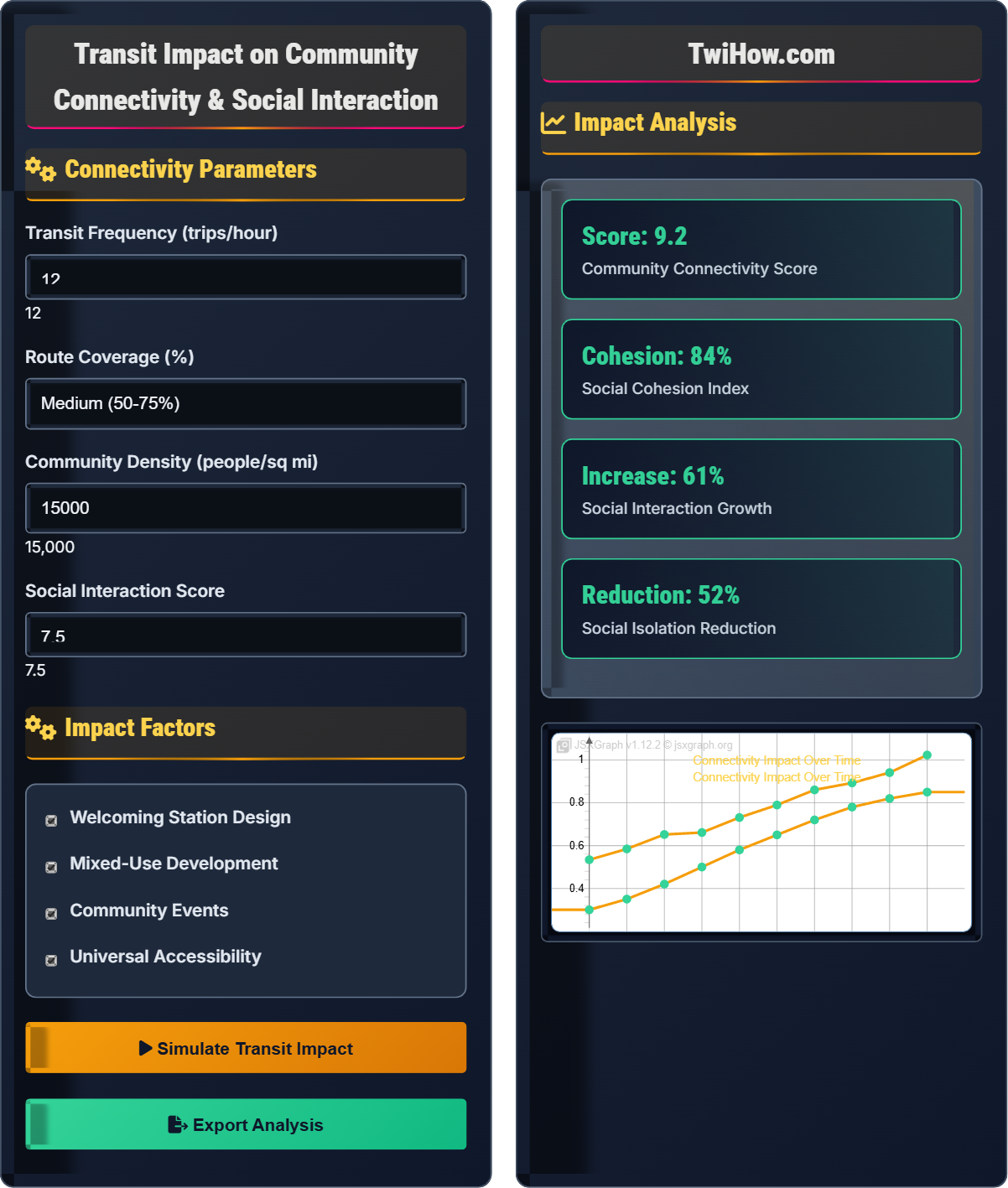
Impact Analysis
| Factor | Current | With Transit | Improvement |
|---|---|---|---|
| Community Interaction | 40% | 75% | +35% |
| Neighborhood Access | 55% | 85% | +30% |
| Social Capital | 35% | 65% | +30% |
| Isolation Reduction | 25% | 57% | +32% |
Transit Impact on Community Connectivity & Social Interaction
Transit connectivity refers to the degree to which public transportation systems link communities, facilitate social interaction, and strengthen community bonds. This includes both physical connections between neighborhoods and the social connections that emerge through shared transit experiences.
Transit connectivity follows a structured framework:
Where:
- Transit Access: Availability and frequency of service
- Social Interaction: Opportunities for community engagement
- Physical Integration: Connection to community spaces and amenities
- Barriers: Physical, social, or economic obstacles
- Isolation Factors: Geographic or demographic separation
- Community Engagement: Active participation in transit planning
Key areas where transit connectivity creates social impact:
- Neighborhood Integration: Connecting diverse communities and cultures
- Social Capital Building: Creating networks and relationships
- Community Identity: Developing shared civic pride and belonging
- Access to Opportunities: Connecting residents to jobs and services
- Reduced Isolation: Providing mobility for vulnerable populations
- Cultural Exchange: Facilitating interaction between different backgrounds
- Hub-and-Spoke: Central stations connecting surrounding neighborhoods
- Grid Network: Interconnected routes creating multiple pathways
- Linear Corridor: Transit along major streets connecting communities
- Feeder System: Local routes feeding into major transit lines
- Express Network: High-speed connections between distant communities
- Community Circuits: Local loops serving specific neighborhoods
Fundamentals of Transit Connectivity
Community connectivity, social cohesion, social capital, neighborhood integration, transit accessibility, community interaction, social interaction, public space.
Connectivity Score = (Access × Interaction × Integration) / (Barriers × Isolation)
Where higher values indicate stronger community connectivity.
- Transit creates shared public spaces for interaction
- Frequency and reliability increase social mixing
- Design elements influence community engagement
Applications
Neighborhood development, social integration, community building, accessibility improvement, social capital development, cultural exchange.
- Transit-oriented development
- Community engagement planning
- Neighborhood integration projects
- Social service accessibility
- Cultural programming around transit
- Community demographics and needs
- Existing social networks and barriers
- Physical infrastructure and design
Transit Connectivity Quiz
How does public transit contribute to social capital formation in communities?
Public transit creates opportunities for regular interaction between diverse community members during waiting times, shared rides, and at transit stations. These repeated encounters foster familiarity, trust, and potential relationships that form the basis of social capital - the networks and norms that facilitate collective action and community cooperation.
The answer is B) By creating opportunities for interaction and relationship building.
Social capital refers to the networks of relationships that enable collective action and community cooperation. Transit systems serve as social infrastructure where people from different backgrounds encounter each other regularly. These repeated, low-stakes interactions can develop into stronger social ties that strengthen community bonds and facilitate collective problem-solving.
Social Capital: Networks of relationships that enable cooperation
Repeated Encounters: Regular interactions that build familiarity
Collective Action: Community cooperation toward common goals
• Regular interaction builds social trust
• Shared spaces facilitate relationship formation
• Diverse encounters strengthen community bonds
• Design transit spaces to encourage interaction
• Create comfortable waiting areas
• Foster community events around transit
• Focusing only on efficiency over social function
• Not considering social interaction in design
• Ignoring community building potential
Explain how transit systems can bridge socioeconomic divides and promote community integration.
Transit as Integration Tool: Public transit naturally brings together people from different socioeconomic backgrounds since it serves all income levels. Unlike private transportation, transit creates shared experiences and spaces where diverse populations interact regularly.
Integration Mechanisms:
1. Geographic Access: Connecting affluent and low-income areas, creating economic opportunities
2. Shared Spaces: Stations and vehicles as neutral ground for interaction
3. Common Purpose: Everyone uses transit for similar goals (work, shopping, etc.)
4. Reduced Segregation: Breaking down geographic barriers that separate communities
5. Employment Access: Connecting workers to job opportunities across economic zones
6. Service Access: Providing equal access to healthcare, education, and services
Transit systems serve as democratic infrastructure where social and economic barriers are temporarily suspended. People from different backgrounds share the same space, follow the same rules, and pursue similar goals. This creates opportunities for cross-cutting relationships that transcend traditional social divisions. Regular interaction in these neutral spaces can break down stereotypes and build mutual understanding.
Community Integration: Breaking down social and economic barriers
Cross-Cutting Ties: Relationships that span social divisions
Neutral Ground: Shared spaces without inherent status markers
• Shared experiences build mutual understanding
• Neutral spaces reduce status barriers
• Regular interaction strengthens cross-cutting ties
• Design inclusive transit spaces
• Promote positive interactions through programming
• Connect diverse neighborhoods intentionally
• Creating transit that reinforces segregation
• Not considering social integration in planning
• Focusing only on efficiency over community building
A study found that 35% of seniors in a suburban community reported feeling socially isolated. After implementing a new transit system that connects them to downtown and community centers, isolation dropped to 18%. Calculate the percentage reduction in social isolation and explain the mechanisms behind this improvement. Assume the community has 2,500 seniors.
Calculations:
• Initial isolated seniors: 2,500 × 0.35 = 875 people
• Post-transit isolated seniors: 2,500 × 0.18 = 450 people
• Reduction in isolated seniors: 875 - 450 = 425 people
• Percentage reduction: (425 ÷ 875) × 100 = 48.6%
Improvement Mechanisms:
• Access to social activities at community centers
• Opportunities for regular interaction during transit
• Connection to family, friends, and services
• Participation in community events and programs
Result: The transit system reduced social isolation by 48.6% among seniors, demonstrating significant community connectivity benefits.
This example demonstrates how transit directly addresses social isolation, particularly among vulnerable populations like seniors. Physical mobility is closely linked to social mobility. When people can easily access community spaces and social opportunities, their isolation decreases significantly. The high percentage reduction shows that transportation barriers were a major contributor to isolation.
Social Isolation: Lack of social connections and community engagement
Transportation Barriers: Mobility limitations affecting social access
Vulnerable Populations: Groups needing special mobility consideration
• Mobility barriers directly affect social connection
• Transit can significantly reduce isolation
• Community access improves social outcomes
• Prioritize transit access for vulnerable populations
• Connect to community gathering places
• Consider frequency and reliability for regular users
• Not considering social impacts in transit planning
• Focusing only on economic efficiency
• Ignoring vulnerable population needs
You're designing a new transit station in a diverse, multilingual community. How would you incorporate design elements that promote social interaction and community connectivity while being accessible to all residents?
Design Elements for Social Interaction:
1. Comfortable Seating Areas: Benches arranged to encourage conversation, with some facing each other
2. Community Information Displays: Multilingual signage showcasing local events and organizations
3. Interactive Features: Community bulletin boards, local art installations, or small performance spaces
4. Universal Accessibility: Ramps, elevators, tactile indicators, and audio announcements
5. Sheltered Spaces: Weather protection encouraging linger time
6. Wayfinding Clarity: Simple, intuitive navigation for diverse users
Community Programming: Host events like farmers markets, cultural celebrations, or community meetings at the station.
Transit stations serve as community anchors that can foster social interaction through thoughtful design. The physical environment influences social behavior - comfortable, welcoming spaces encourage people to linger and interact. Multilingual accessibility ensures all community members can participate. Programming creates intentional opportunities for community building around transit infrastructure.
Community Anchors: Infrastructure that brings people together
Universal Design: Accessible to all users regardless of ability
Intentional Programming: Planned activities to foster interaction
• Design should encourage rather than discourage interaction
• Accessibility is essential for true community integration
• Programming amplifies the social function of transit spaces
• Engage community in design process
• Create flexible spaces for various activities
• Ensure maintenance supports social function
• Creating sterile, unwelcoming transit-only spaces
• Not considering diverse community needs
• Focusing only on efficiency over community function
Which aspect of transit design most effectively promotes cultural exchange and understanding between diverse communities?
Longer wait times at stations with community spaces most effectively promote cultural exchange because they create opportunities for interaction between diverse passengers. When people have time to wait and comfortable spaces to do so, they're more likely to engage in casual conversations, observe different cultural expressions, and build understanding across community lines.
The answer is B) Longer wait times at stations with community spaces.
While efficiency is important, the social function of transit should not be overlooked. Moments of waiting create natural opportunities for interaction. Well-designed transit spaces that encourage lingering and interaction can become venues for cultural exchange. The key is balancing efficiency with social function to create transit systems that serve both mobility and community needs.
Cultural Exchange: Sharing of traditions, perspectives, and experiences
Social Function: Community-building purpose of infrastructure
Interaction Opportunities: Moments that enable social contact
• Transit serves both mobility and social functions
• Design should balance efficiency with community building
• Waiting spaces can facilitate positive interaction
• Create comfortable, attractive waiting areas
• Include cultural programming and displays
• Design for both efficiency and social interaction
• Prioritizing only speed over social function
• Creating unwelcoming transit environments
• Not considering cultural diversity in design
FAQ
Q: How can transit systems promote social cohesion in diverse communities?
A: Transit systems can promote social cohesion by:
Creating Shared Spaces: Well-designed stations that welcome all community members
Ensuring Universal Access: Accessibility for people with disabilities and diverse needs
Connecting Diverse Areas: Linking neighborhoods with different demographics
Providing Equal Service: Consistent, reliable service across all communities
Facilitating Interaction: Comfortable spaces that encourage positive encounters
Supporting Community Events: Programming that celebrates diversity
Engaging All Voices: Inclusive planning processes that reflect community needs
Successful transit systems become symbols of shared community investment that bring people together.
Q: What are the main challenges in designing transit for community connectivity?
A: Main challenges include:
Cost Considerations: Balancing social benefits with economic efficiency
Community Resistance: NIMBY attitudes toward transit development
Design Conflicts: Efficiency vs. social interaction space needs
Cultural Sensitivity: Respecting diverse community preferences
Equity Concerns: Ensuring fair service across all communities
Physical Constraints: Existing infrastructure limitations
Political Barriers: Short-term political cycles vs. long-term benefits
Successful transit planning requires addressing these challenges through community engagement and balanced design.