Best Cities to Visit: Complete Guide
Top destinations • Rankings • Travel insights
City Travel Overview:
Find Best CitiesThe world's greatest cities offer unique combinations of culture, history, entertainment, and experiences that attract millions of travelers annually. From iconic landmarks and world-class museums to vibrant neighborhoods and culinary scenes, the best travel cities provide unforgettable experiences for diverse interests and travel styles.
Key factors that make cities desirable include:
- Cultural Heritage: Historical significance and cultural landmarks
- Accessibility: Transportation infrastructure and ease of navigation
- Diversity: Neighborhoods, cuisines, and experiences
- Safety: Overall security and tourist-friendly environment
- Value: Affordability and cost of living for travelers
Choosing the right city depends on your interests, budget, travel style, and desired experiences. This guide helps you discover the world's most remarkable destinations.
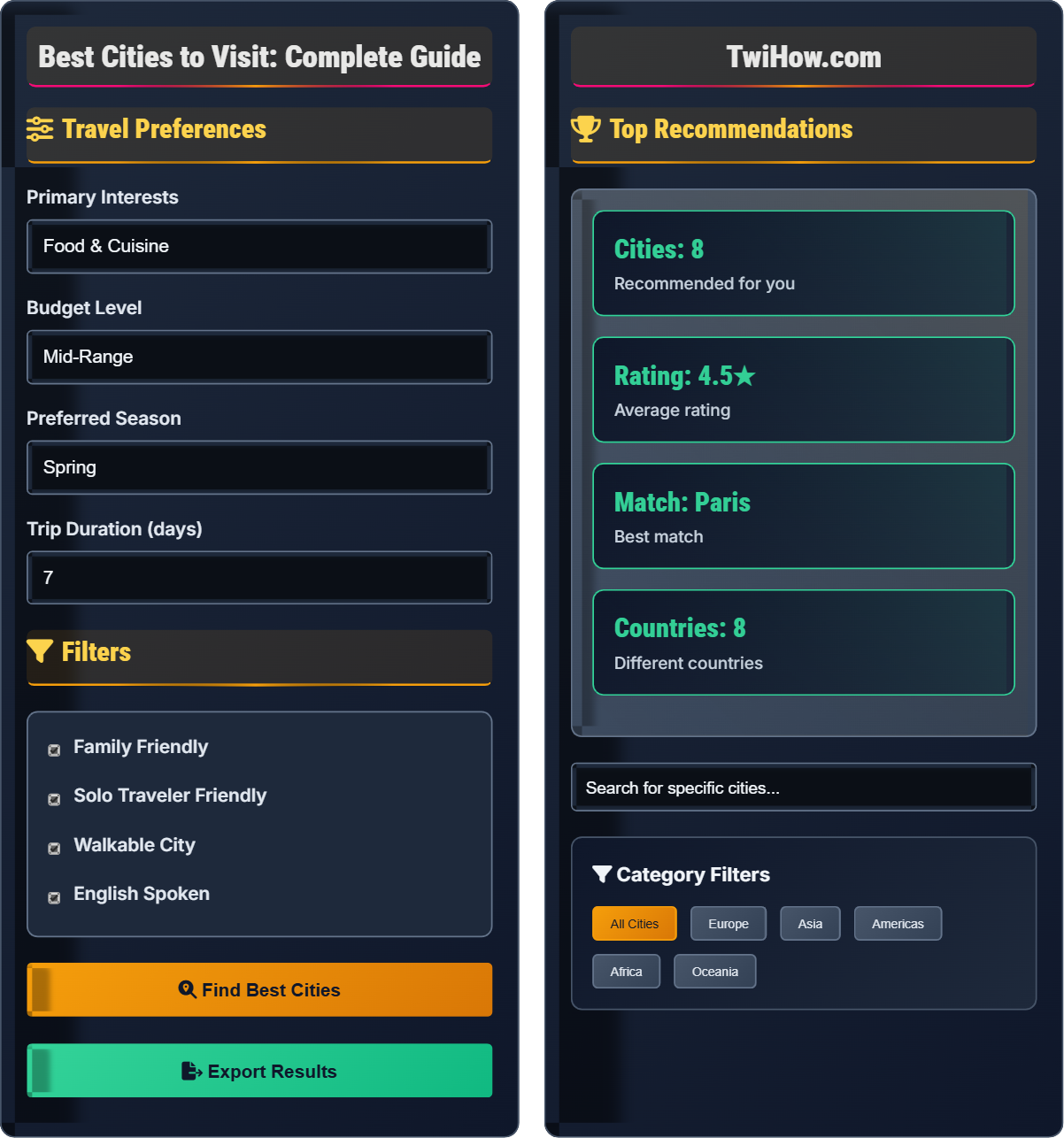
Travel Preferences
Filters
Top Recommendations
Category Filters
| Rank | City | Country | Rating | Popularity | Best For |
|---|---|---|---|---|---|
| 1 | Paris | France | 4.8★ | 95% | Romance, Culture |
| 2 | Kyoto | Japan | 4.7★ | 92% | History, Tradition |
| 3 | New York | USA | 4.6★ | 98% | Culture, Entertainment |
| 4 | Bangkok | Thailand | 4.6★ | 90% | Food, Nightlife |
| 5 | Rome | Italy | 4.5★ | 94% | History, Food |
Understanding City Tourism
The world's best travel cities combine multiple factors that create memorable experiences for visitors. These include cultural richness, accessibility, safety, variety of attractions, and overall visitor satisfaction.
Key factors that contribute to a city's appeal:
- Cultural Heritage: Historical landmarks, museums, and cultural institutions
- Gastronomy: Local cuisine, street food, and fine dining options
- Infrastructure: Transportation, accommodation, and tourist services
- Safety: Low crime rates and tourist-friendly environment
- Accessibility: Ease of navigation and transportation options
Different regions offer unique city experiences based on their geography, culture, and development:
European Cities: Rich history, architectural beauty, cultural institutions, and compact layouts.
Asian Cities: Vibrant street life, diverse cuisine, modern infrastructure, and cultural traditions.
American Cities: Cultural diversity, entertainment options, modern attractions, and urban innovation.
African Cities: Natural beauty, cultural authenticity, wildlife proximity, and emerging tourism infrastructure.
The best time to visit cities varies by location and desired experience:
Spring: Mild weather, blooming flowers, fewer crowds in many destinations.
Summer: Peak tourist season, warm weather, outdoor festivals and activities.
Fall: Comfortable temperatures, autumn colors, harvest festivals.
Winter: Holiday markets, winter sports, holiday atmosphere, off-season discounts.
City costs vary significantly based on location, lifestyle, and travel style:
Budget-Friendly: Southeast Asia, Eastern Europe, Central America offer excellent value.
Mid-Range: Western Europe, Australia, Canada provide good balance of quality and cost.
Premium: Major metropolises like New York, London, Tokyo offer luxury experiences.
Money-Saving Tips: Street food, public transportation, free attractions, and off-season travel.
Choose cities that match your preferred travel style and interests:
Active Travelers: Cities with outdoor activities, walking tours, and adventure opportunities.
Culture Enthusiasts: Cities rich in museums, historical sites, and cultural events.
Food Lovers: Cities renowned for local cuisine, street food, and culinary experiences.
Relaxation Seekers: Cities with parks, spas, and leisurely-paced activities.
City Travel Categories
Cultural capitals, cosmopolitan hubs, historic centers, beach cities, mountain towns, and emerging destinations.
Visitor satisfaction, accessibility, safety, attractions, infrastructure, and overall experience quality.
- Research local customs and etiquette
- Plan for transportation and navigation
- Consider seasonal weather patterns
- Respect local communities and environment
City Travel Planning
Research, booking, transportation, accommodation, and cultural preparation.
- Research destination and attractions
- Plan transportation and accommodation
- Create flexible itinerary
- Prepare for cultural differences
- Allow flexibility in your schedule
- Balance popular attractions with local experiences
- Learn basic local phrases
- Respect local customs and regulations
City Travel Trends & Insights
Sample 7-Day Paris Itinerary
City Travel Knowledge Quiz
Which factor is most important when selecting a city for a first-time international trip?
English language prevalence and infrastructure are most important for first-time international travelers. Good infrastructure (public transportation, signage, tourist services) and English-speaking locals reduce stress and make navigation easier. While attractions, weather, and cost matter, they're secondary to the ability to navigate safely and communicate effectively in an unfamiliar environment.
The answer is B) English language prevalence and infrastructure.
For first-time international travelers, the priority should be on reducing barriers to communication and navigation. Infrastructure supports the basic logistics of travel, while language facilitates help-seeking and cultural interaction. These foundational elements create a secure base from which travelers can enjoy attractions, weather, and cost benefits.
Infrastructure: Basic systems and services that support city operations
Language Prevalence: Percentage of population speaking a particular language
First-Time Traveler: Someone traveling internationally for the first time
• Prioritize communication and navigation
• Choose destinations with good infrastructure
• Consider support systems for beginners
• Start with English-speaking countries
• Choose cities with good public transport
• Research before departure
• Choosing destinations based solely on attractions
• Ignoring language barriers
• Not considering infrastructure quality
Explain the importance of cultural sensitivity when visiting cities in different countries and provide specific examples of how travelers can respect local customs and traditions. How does this enhance the travel experience?
Importance of Cultural Sensitivity: Cultural sensitivity demonstrates respect for local communities and helps travelers avoid misunderstandings or offenses. It enriches the travel experience by providing deeper insights into the destination and fostering positive interactions with locals.
Specific Examples of Respectful Behavior:
Dress Appropriately: Cover shoulders and knees when visiting religious sites, follow local dress codes in conservative areas.
Learn Basic Phrases: Greetings, thank you, and polite expressions in the local language show respect and effort.
Follow Local Customs: Remove shoes before entering homes/temples, use proper greeting gestures, respect prayer times.
Photography Etiquette: Ask permission before photographing people, respect no-camera signs, avoid intrusive photography.
Support Local Businesses: Shop at local markets, eat at family-owned restaurants, buy authentic crafts.
Enhanced Experience: Cultural sensitivity opens doors to authentic experiences, meaningful conversations with locals, and insider knowledge about the destination. It transforms tourism from superficial sightseeing to meaningful cultural exchange.
Cultural sensitivity operates on multiple levels: practical (avoiding offense), ethical (showing respect), and experiential (enhancing travel quality). When travelers demonstrate genuine interest in and respect for local customs, they often receive warmer welcomes and access to experiences unavailable to insensitive visitors.
Cultural Sensitivity: Awareness and respect for different cultural practices
Local Customs: Traditional practices and behaviors of a community
Cultural Exchange: Mutual sharing of cultural knowledge and experiences
• Research customs before traveling
• Observe and follow local practices
• Show respect for cultural differences
• Download cultural etiquette apps
• Watch local behavior for cues
• Apologize if you make mistakes
• Assuming all cultures are similar
• Not researching local customs
• Disrespecting religious practices
Sarah is planning a 10-day trip to Europe and wants to visit 3 cities. She has a mid-range budget ($2,500) and is interested in culture, history, and food. She prefers walkable cities with good public transportation. Recommend a 3-city itinerary that maximizes her interests while considering travel time between destinations and budget constraints.
Recommended 3-City Itinerary:
City 1: Rome, Italy (4 days)
• Rich cultural heritage with Colosseum, Vatican, and ancient ruins
• Excellent food scene with authentic Italian cuisine
• Walkable historic center with good metro system
• Mid-range budget: €80-120/day including accommodation and meals
City 2: Florence, Italy (3 days)
• Renaissance art and architecture, compact walkable city
• Renowned Tuscan cuisine and wine culture
• Easy train connection from Rome (1.5 hours)
• Mid-range budget: €70-100/day
City 3: Venice, Italy (3 days)
• Unique canal city with incredible architecture
• Distinctive Venetian cuisine and seafood
• Easy train connection from Florence (2 hours)
• Mid-range budget: €90-130/day
Benefits: Same country (no currency exchange), efficient train travel, rich cultural experiences, diverse food scenes, walkable cities, and reasonable budget distribution.
Effective city combination considers geographic proximity, cultural coherence, transportation efficiency, and budget allocation. The Italy example maximizes cultural and culinary experiences while minimizing travel time and complexity. The sequence moves from larger to smaller cities, providing a logical progression from bustling metropolis to intimate historical centers.
Walkable City: Urban area navigable primarily by foot
Transportation Efficiency: Minimal time spent traveling between destinations
Cultural Coherence: Logical connection between destinations
• Minimize travel time between cities
• Use train passes for European travel
• Book accommodations in central locations
• Research free attractions
• Choosing cities too far apart
• Underestimating transportation time
• Not considering accommodation location
You're developing a city recommendation system that considers seasonal factors. Identify three major cities and explain how their appeal varies by season, including specific activities, weather considerations, and tourist crowd levels for each season.
Paris, France:
Spring (Mar-May): Mild weather, blooming flowers, fewer crowds, ideal for outdoor activities and sightseeing.
Summer (Jun-Aug): Warm weather, peak tourist season, outdoor cafes and festivals, crowded attractions.
Fall (Sep-Nov): Pleasant weather, beautiful foliage, moderate crowds, excellent dining season.
Winter (Dec-Feb): Cool weather, holiday markets, light crowds, cozy indoor activities and museums.
Bangkok, Thailand:
Winter (Nov-Feb): Cool dry season, ideal weather, peak tourist season, best time for outdoor activities.
Summer (Mar-May): Hot and humid, fewer tourists, lower prices, indoor activities recommended.
Rainy Season (Jun-Oct): Frequent rain showers, lush greenery, lowest prices, indoor attractions.
New York City, USA:
Spring: Blooming parks, mild weather, moderate crowds, outdoor activities begin.
Summer: Warm weather, outdoor concerts, peak crowds, rooftop bars and beaches.
Fall: Beautiful autumn colors, comfortable weather, busy with tourists, excellent dining.
Winter: Cold weather, holiday decorations, ice skating, Broadway shows and indoor activities.
Seasonal variation significantly impacts city appeal based on climate, tourist patterns, and available activities. A sophisticated recommendation system must weigh these factors against traveler preferences. Some travelers prefer peak seasons for maximum activities, while others seek off-season for better prices and fewer crowds.
Peak Season: Highest tourist activity period
Off-Season: Lowest tourist activity period
Shoulder Season: Transitional period between peak and off-season
• Consider weather patterns
• Account for tourist crowds
• Match activities to seasons
• Research seasonal weather patterns
• Consider crowd levels vs. activities
• Factor in price variations
• Not considering seasonal weather
• Ignoring tourist crowd patterns
• Not matching activities to seasons
Which strategy is most effective for experiencing a city's authentic culture while staying within a budget?
Using public transportation, shopping at local markets, and eating street food is the most effective strategy for authentic cultural experiences on a budget. These activities provide insight into daily local life, offer genuine cultural interactions, and are typically much more affordable than tourist-oriented alternatives. Public transportation reveals how locals move around the city, markets showcase local products and customs, and street food represents authentic cuisine at affordable prices.
The answer is B) Use public transportation, shop at local markets, and eat street food.
Authentic cultural experiences often occur in everyday settings where locals live and work. Tourist-oriented services, while convenient, tend to be more expensive and less representative of genuine local culture. The most meaningful cultural exchanges happen when travelers engage with the same systems and services used by residents, creating opportunities for authentic interactions and cultural learning.
Authentic Experience: Genuine cultural interaction reflecting local reality
Tourist Bubble: Environment isolated from local culture
Cultural Immersion: Deep engagement with local customs and practices
• Engage with local systems and services
• Seek authentic cultural interactions
• Balance budget with experience quality
• Use local transportation
• Shop at neighborhood markets
• Try street food and local restaurants
• Staying in tourist areas only
• Only visiting tourist attractions
• Avoiding local establishments
City Travel FAQ
Q: How do I choose between similar cities like Paris, London, and Rome for my first European trip? What factors should I consider?
A: When choosing between similar major European cities, consider these factors:
Interests: Paris for romance and art, London for history and culture, Rome for ancient history and food.
Language: London (English), Paris (French), Rome (Italian) - consider your comfort with language barriers.
Season: Weather and crowd levels vary by season in each city.
Transportation: London's extensive underground, Paris's metro, Rome's walkable historic center.
Budget: London tends to be most expensive, Paris mid-range, Rome relatively more affordable.
Duration: Each city deserves 3-4 days minimum to truly experience its character.
Consider what appeals to you most: artistic masterpieces (Paris), royal history (London), or ancient ruins (Rome).
Q: How can I experience authentic local culture in major cities without falling into tourist traps?
A: To experience authentic local culture:
Explore Beyond Tourist Centers: Venture into residential neighborhoods and local districts.
Use Public Transportation: Ride buses and trains alongside locals to see the city from their perspective.
Shop at Local Markets: Visit neighborhood markets rather than tourist-focused shopping areas.
Attend Local Events: Check local newspapers and community boards for festivals, concerts, and cultural events.
Ask Locals for Recommendations: Strike up conversations with residents for authentic suggestions.
Early Morning Exploration: Visit popular sites early when locals are out for morning routines.
Learn Basic Phrases: Showing effort in the local language opens doors to authentic interactions.
The key is engaging with the city as a resident would, not just as a tourist.