Best Mountains: Complete Guide
Top destinations • Rankings • Travel insights
Mountain Travel Overview:
Find Best MountainsThe world's most spectacular mountains offer breathtaking landscapes, challenging adventures, and unparalleled natural beauty. From towering peaks and glacial valleys to alpine meadows and pristine wilderness, mountains provide diverse experiences for hikers, climbers, photographers, and nature enthusiasts. Each mountain destination offers unique opportunities for outdoor activities, cultural exploration, and personal achievement.
Key characteristics of world-class mountains include:
- Natural Beauty: Dramatic landscapes, panoramic views, and pristine environments
- Accessibility: Well-maintained trails, infrastructure, and visitor services
- Activities: Hiking, climbing, skiing, photography, and wildlife viewing
- Safety: Proper trail marking, emergency services, and safety measures
- Cultural Significance: Historical importance and local traditions
Choosing the right mountain depends on your experience level, interests, budget, and desired activities. This guide helps you discover the world's most remarkable mountain destinations.
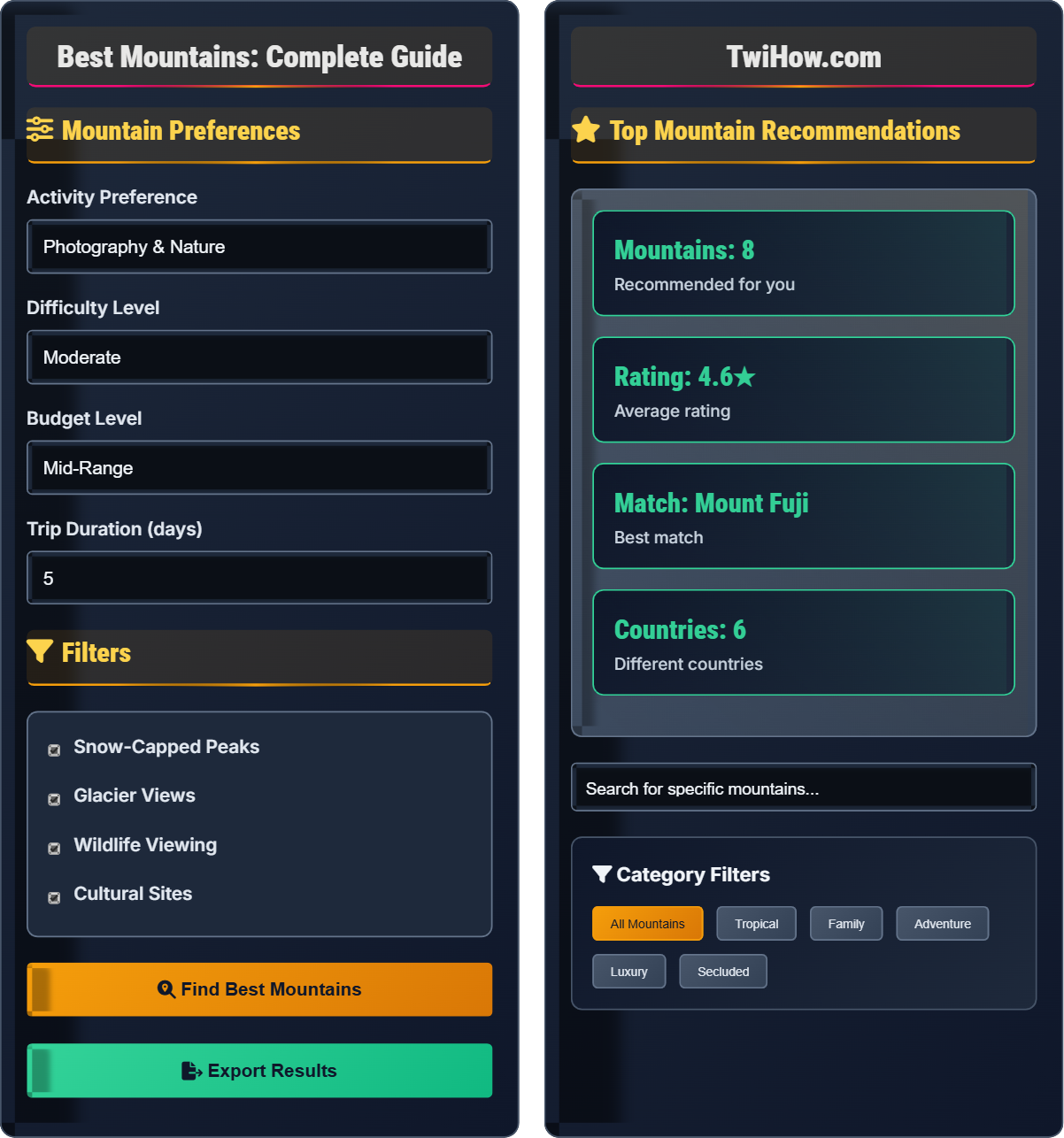
Mountain Preferences
Filters
Top Mountain Recommendations
Category Filters
| Rank | Mountain | Country | Rating | Popularity | Best For |
|---|---|---|---|---|---|
| 1 | Mount Fuji | Japan | 4.8★ | 95% | Photography, Culture |
| 2 | Mount Kilimanjaro | Tanzania | 4.7★ | 92% | Climbing, Adventure |
| 3 | Mount Everest | Nepal | 4.7★ | 88% | Adventure, Achievement |
| 4 | Rocky Mountains | USA | 4.6★ | 98% | Hiking, Wildlife |
| 5 | Alps | Europe | 4.5★ | 96% | Skiing, Scenery |
Understanding Mountain Tourism
The world's best mountains combine multiple factors that create memorable experiences for visitors. These include natural beauty, accessibility, safety, activities, and overall visitor satisfaction.
Key factors that contribute to a mountain's appeal:
- Natural Beauty: Stunning landscapes, panoramic views, and pristine environments
- Accessibility: Well-maintained trails, infrastructure, and visitor services
- Activities: Hiking, climbing, skiing, photography, and wildlife viewing
- Safety: Proper trail marking, emergency services, and safety measures
- Cultural Significance: Historical importance and local traditions
Different regions offer unique mountain experiences based on their geography, climate, and development:
Alpine Mountains: High peaks, glaciers, and year-round snow with excellent skiing and climbing opportunities.
Tropical Mountains: Cloud forests, biodiversity, and unique ecosystems with year-round climbing seasons.
Desert Mountains: Dramatic landscapes, unique geology, and extreme conditions with specialized activities.
Coastal Mountains: Ocean views, diverse ecosystems, and combined land-sea experiences.
The best time to visit mountains varies by location and desired experience:
Summer: Peak hiking season, warm weather, maximum trail accessibility.
Winter: Skiing, snowboarding, and winter sports with specialized equipment.
Spring/Fall: Mild weather, fewer crowds, beautiful seasonal changes.
Shoulder Season: Good balance of weather and crowds with lower prices.
Mountain destinations vary significantly based on location and lifestyle:
Budget-Friendly: Local mountains, camping, and self-guided adventures.
Mid-Range: Guided tours, comfortable accommodations, and organized activities.
Premium: Luxury lodges, professional guiding, and exclusive experiences.
Money-Saving Tips: Off-season travel, group discounts, and DIY planning.
Choose mountains that match your preferred travel style and interests:
Adventure Seekers: Challenging peaks, technical climbs, and extreme conditions.
Photography Lovers: Scenic viewpoints, unique lighting, and stunning landscapes.
Family Travelers: Easy trails, safe conditions, and educational opportunities.
Wildlife Enthusiasts: Biodiversity, animal viewing, and ecological experiences.
Mountain Travel Categories
Alpine peaks, tropical mountains, desert ranges, coastal mountains, volcanic peaks, and cultural mountains.
Scenic beauty, accessibility, safety measures, activity variety, and overall experience quality.
- Check weather and trail conditions
- Research altitude and acclimatization needs
- Consider seasonal variations
- Respect local communities and environment
Mountain Travel Planning
Research, booking, transportation, accommodation, and activity planning.
- Research destination and trail conditions
- Plan transportation and accommodation
- Create flexible itinerary
- Prepare for altitude and weather
- Allow flexibility in your schedule
- Balance challenging activities with rest
- Prepare for altitude sickness
- Respect local customs and regulations
Mountain Travel Essentials
Weather Changes: Monitor forecasts, prepare for sudden changes
Trail Marking: Follow marked trails, carry navigation tools
Emergency Preparedness: Carry emergency supplies, inform others of plans
Sample 5-Day Mount Fuji Itinerary
Mountain Travel Knowledge Quiz
What is the most important safety practice when ascending to high altitudes?
Ascending slowly to allow for acclimatization is the most important safety practice at high altitudes. Rapid ascent increases the risk of altitude sickness, which can be life-threatening. The body needs time to adjust to lower oxygen levels by producing more red blood cells and adjusting breathing patterns. The general rule is to not increase sleeping altitude by more than 300-500 meters per day above 3,000 meters.
The answer is B) Ascend slowly to allow for acclimatization.
Acclimatization is the body's physiological adaptation to high altitude conditions. This process involves increased breathing rate, higher heart rate, and production of additional red blood cells to compensate for reduced oxygen availability. Proper acclimatization prevents altitude sickness, which can manifest as headaches, nausea, dizziness, and in severe cases, pulmonary or cerebral edema.
Acclimatization: Physiological adaptation to high altitude
Altitude Sickness: Illness caused by rapid altitude ascent
Red Blood Cells: Cells that carry oxygen in the blood• Ascend slowly above 3,000m
• Sleep at lower altitude if possible
• Stay hydrated and eat well
• Plan rest days during ascent
• Recognize early symptoms
• Descend immediately if severe symptoms occur
• Ascending too quickly
• Ignoring early symptoms
• Not preparing adequately
Explain the essential gear needed for different types of mountain activities (hiking, climbing, winter sports) and how the gear differs based on activity level and season.
Hiking Gear:
• Sturdy hiking boots with ankle support
• Moisture-wicking base layers and insulating layers
• Waterproof jacket and pants
• Backpack with rain cover
• Navigation tools (map, compass, GPS)
Climbing Gear:
• Rock climbing shoes for technical routes
• Harness, helmet, and rope
• Carabiners, cams, and protection devices
• Climbing-specific backpack
• Technical clothing for movement
Winter Sports Gear:
• Insulated, waterproof outer layers
• Ski or snowboard equipment
• Avalanche safety equipment (beacon, probe, shovel)
• Goggles and insulated gloves
• Winter-specific boots
Seasonal Variations:
Summer: Lighter layers, sun protection, breathable fabrics
Winter: Insulated layers, wind protection, moisture management
Spring/Fall: Mixed layers for temperature fluctuations
Gear should match activity level, weather conditions, and duration of exposure.
Mountain gear selection is critical for safety and comfort. The key is layering systems that can be adjusted for changing conditions. Each activity requires specialized equipment that addresses specific risks and needs. Proper gear prevents hypothermia, frostbite, and other environmental hazards while enabling safe participation in activities.
Layering System: Clothing worn in layers for temperature regulation
Environmental Hazards: Natural dangers in mountain environments
Technical Gear: Specialized equipment for specific activities
• Test gear before major trips
• Match gear to activity level
• Always carry emergency equipment
• Invest in quality base layers
• Pack extra socks and underwear
• Use gear checklists
• Wearing cotton in wet conditions
• Not having proper footwear
• Forgetting emergency supplies
Sarah is planning a 7-day mountain hiking trip with her family of 4 (including 2 teenagers). She wants a family-friendly destination with moderate difficulty trails, beautiful scenery, and safe conditions. Recommend a suitable mountain destination and create a 3-day hiking itinerary that accommodates both beginners and experienced hikers.
Recommended Destination: Rocky Mountains, Colorado
• Family-friendly with trails for all skill levels
• Excellent facilities and ranger services
• Beautiful scenery and wildlife viewing opportunities
• Well-marked trails with safety measures
3-Day Hiking Itinerary:
Day 1: Easy Exploration
• Morning: Lake Isabella Trail (2 miles, easy)
• Afternoon: Visitor center and educational activities
• Evening: Campfire and storytelling
Day 2: Moderate Challenge
• Morning: Bear Lake to Emerald Lake (3.6 miles, moderate)
• Afternoon: Picnic lunch and wildlife watching
• Evening: Stargazing and astronomy discussion
Day 3: Advanced Option
• Morning: Family chooses between easy or moderate trails
• Afternoon: Rock climbing lessons for beginners
• Evening: Reflection and planning for next adventure
This plan balances different skill levels while ensuring safety and enjoyment for all family members.
Family mountain planning requires balancing different skill levels, energy levels, and interests. The key is variety in activities, safety prioritization, and flexibility in scheduling. Age-appropriate activities ensure engagement while respecting different physical capabilities and safety requirements.
Family-Friendly: Suitable for all age groups with safety measures
Age-Appropriate: Activities suitable for specific age ranges
Activity Balance: Mix of active and passive pursuits
• Prioritize child safety
• Plan age-appropriate activities
• Include rest periods
• Pack snacks and drinks
• Schedule rest time
• Bring entertainment for downtime
• Planning too many activities
• Not considering skill levels
• Ignoring safety needs
You're developing a sustainable mountain travel guide. Identify the key environmental considerations for mountain visitors and explain how travelers can minimize their impact while enjoying mountain destinations.
Key Environmental Considerations:
Ecosystem Fragility: Mountain ecosystems are delicate and slow to recover from disturbance. Vegetation grows slowly at high altitudes.
Wildlife Protection: Avoid disturbing nesting birds, hibernating animals, and sensitive breeding areas.
Water Source Protection: Protect streams and lakes from contamination by using proper waste disposal and washing practices.
Trail Preservation: Stay on designated paths to prevent erosion and vegetation damage.
Sustainable Practices:
• Follow Leave No Trace principles
• Pack out all waste and trash
• Use established campsites
• Minimize campfire impact
• Respect wildlife and observe from distance
• Use eco-friendly products
• Support local conservation efforts
Travelers should follow the "Leave No Trace" principle by minimizing impact and preserving natural beauty for future generations.
Sustainable mountain travel requires awareness of environmental impacts and responsible behavior. Mountain ecosystems are fragile and can be easily damaged by human activities. Travelers have a responsibility to preserve these natural treasures while enjoying them, ensuring future generations can experience the same beauty.
Sustainable Tourism: Travel that minimizes environmental impact
Leave No Trace: Principle of minimizing environmental impact
Ecosystem Fragility: Vulnerability of mountain environments
• Stay on designated trails
• Pack out all waste
• Respect wildlife
• Use established campsites
• Wash dishes away from water sources
• Choose eco-friendly products
• Going off-trail
• Littering in wilderness areas
• Disturbing wildlife
Which factor is most important for determining mountain weather safety and trip planning?
All weather factors combined are most important for determining mountain weather safety. Mountain weather is complex and dynamic, with temperature, wind, visibility, precipitation, and atmospheric pressure all interacting to create conditions that can change rapidly. Wind speed affects exposure and hypothermia risk, visibility impacts navigation safety, and temperature influences overall comfort and safety. A holistic approach to weather assessment considers all factors together rather than focusing on individual elements.
The answer is D) All of the above combined.
Mountain weather assessment requires understanding the interplay between multiple atmospheric factors. Each element affects different aspects of safety and comfort, and conditions can deteriorate rapidly in mountain environments. Weather forecasting for mountains must account for local topography, altitude effects, and microclimates that can create conditions significantly different from valley forecasts.
Microclimate: Local atmospheric conditions influenced by terrain
Atmospheric Pressure: Air pressure that affects weather patterns
Weather Forecasting: Prediction of atmospheric conditions
• Check multiple weather sources
• Monitor conditions continuously
• Plan for rapid changes
• Use mountain-specific forecasts
• Check conditions before departure
• Monitor changes during activities
• Relying on valley forecasts
• Not monitoring conditions
• Ignoring multiple weather factors
Mountain Travel FAQ
Q: What's the difference between various mountain types and which would be best for a first-time mountain experience?
A: Mountain types vary significantly:
Alpine Mountains: High elevation, snow-capped peaks, technical climbing.
Tropical Mountains: Cloud forests, biodiversity, unique ecosystems.
Desert Mountains: Arid conditions, unique geology, extreme temperature variations.
Coastal Mountains: Ocean views, moderate climate, diverse ecosystems.
For First-Time Travelers:
• Choose mountains with good infrastructure and services
• Select destinations with easy-to-moderate trails
• Look for areas with ranger services and emergency support
• Consider family-friendly mountains with educational opportunities
• Avoid extreme altitude or harsh conditions initially
Popular first-time destinations include Rocky Mountains, Blue Ridge Mountains, or Swiss Alps.
Q: What mountain activities are safe and appropriate for different skill levels, and how can I ensure safety while attempting challenging climbs?
A: Mountain activities by skill level:
Beginner:
• Easy hiking trails with clear paths
• Day hikes with minimal elevation gain
• Guided nature walks and educational tours
• Familiarization with basic equipment
Intermediate:
• Moderate trails with elevation gain
• Multi-day backpacking trips
• Basic rock climbing with instruction
• Winter hiking with proper equipment
Advanced:
• Technical climbing routes
• High-altitude expeditions
• Ice climbing and mountaineering
• Alpine route-finding
Safety Tips:
• Always use proper equipment
• Take courses from certified instructors
• Never attempt advanced routes alone
• Check weather and conditions
• Use appropriate safety gear
• Progress gradually and respect your limits
Progress gradually and respect your skill limits.