How to Travel Safely: Complete Guide
Safety strategies • Security measures • Practical tips
Travel Safety Overview:
Assess RiskTravel safety encompasses all measures and precautions taken to protect oneself from harm, theft, or other dangers while traveling. It involves preparation, awareness, and vigilance to minimize risks and ensure a safe journey. Safe travel requires understanding potential threats, taking preventive measures, and knowing how to respond to emergencies.
Key aspects of travel safety include:
- Preparation: Research, documentation, and planning
- Physical Security: Protecting personal belongings and physical safety
- Health Safety: Medical precautions and health considerations
- Communication: Staying connected and informed
- Emergency Preparedness: Knowing how to respond to crises
Effective travel safety combines proactive planning with situational awareness and responsible behavior throughout the journey.
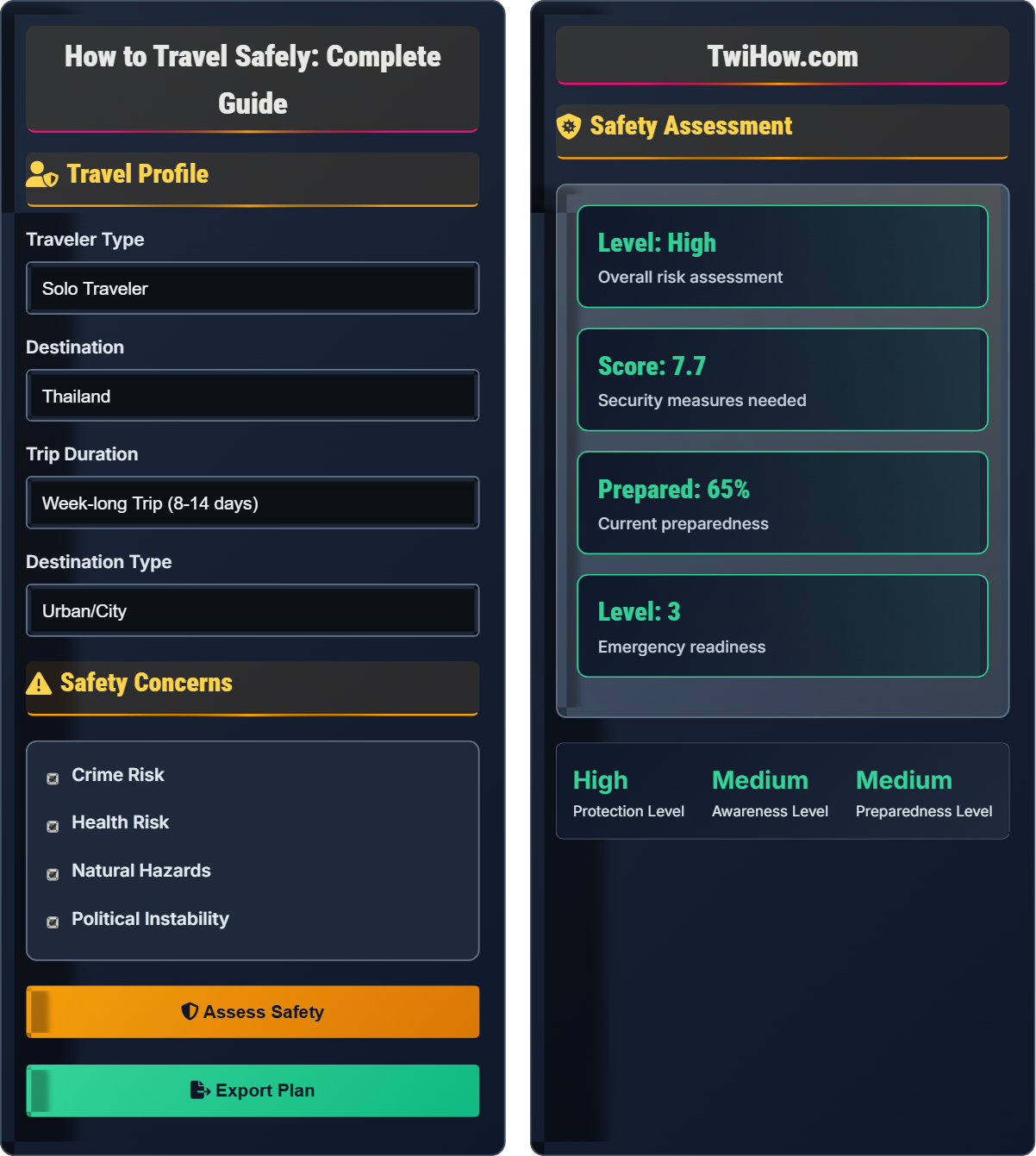
Travel Profile
Safety Concerns
Safety Assessment
Medical: 1669
Fire: 199
Embassy: US Embassy: +66 2 205-4047
Research your destination's safety profile, local customs, and potential risks. Register with your embassy and share travel plans with trusted contacts.
Make copies of important documents and store them separately. Keep digital copies in cloud storage and physical copies with trusted contacts.
Understanding Travel Safety
Travel safety encompasses all measures and precautions taken to protect oneself from harm, theft, or other dangers while traveling. It involves preparation, awareness, and vigilance to minimize risks and ensure a safe journey. Travel safety is not about living in fear, but about being informed and prepared.
Key components of travel safety:
- Preparation: Research, documentation, and planning
- Physical Security: Protecting personal belongings and physical safety
- Health Safety: Medical precautions and health considerations
- Communication: Staying connected and informed
- Emergency Preparedness: Knowing how to respond to crises
Effective travel safety begins with proper risk assessment:
Crime Risk: Theft, assault, scams, and other criminal activities.
Health Risk: Disease, medical emergencies, and health hazards.
Natural Hazards: Weather, natural disasters, and environmental risks.
Political Instability: Civil unrest, protests, and political tensions.
Transportation Risks: Accidents, delays, and safety concerns.
Travel safety can be categorized by different levels of preparation:
Basic Safety: Fundamental precautions for any trip.
Enhanced Safety: Additional measures for higher-risk destinations.
High Security: Maximum precautions for dangerous areas.
Emergency Response: Protocols for crisis situations.
Travel safety spans the entire journey:
Pre-Travel: Research, planning, and preparation.
During Travel: Active vigilance and situational awareness.
Emergency: Crisis response and assistance.
Post-Travel: Documentation and lessons learned.
Different traveler types require different safety approaches:
Solo Travelers: Focus on personal security and communication.
Family Travelers: Emphasize child safety and group coordination.
Business Travelers: Security for sensitive information and materials.
Adventure Travelers: Safety for outdoor and extreme activities.
Safety Categories
Physical security, health safety, communication, emergency preparedness, and documentation.
Overall Risk = Crime Risk + Health Risk + Natural Risk + Political Risk + Transportation Risk.
- Always research your destination
- Keep copies of important documents
- Stay aware of your surroundings
- Inform contacts of your plans
Safety Preparation
Research, documentation, insurance, communication, and emergency planning.
- Research destination safety profile
- Gather necessary documents
- Purchase travel insurance
- Create emergency plans
- Start preparation early
- Keep digital and physical backups
- Research local laws and customs
- Plan for flexibility and changes
Safety Assessment & Planning
Travel Safety Knowledge Quiz
What is the most important document security practice for travelers?
Making copies and storing them separately is the most important document security practice. This follows the principle of redundancy - if original documents are lost, stolen, or damaged, you have backups. Digital copies stored in cloud services and physical copies kept in different locations ensure access to critical information when needed. This is especially important for first-time travelers who may not anticipate potential document issues.
The answer is B) Make copies and store separately.
Document security is fundamental to travel safety. The principle of redundancy ensures that critical information remains accessible regardless of what happens to the originals. This tip is particularly important for international travel where replacing documents can be extremely difficult and time-consuming.
Document Security: Measures to protect important travel documents
Redundancy: Having multiple copies to ensure availability
Backup Access: Alternative means of accessing critical information
• Keep digital copies in cloud storage
• Store physical copies separately
• Share copies with trusted contacts
• Use travel apps for document storage
• Take photos of all documents
• Print copies before travel
• Not making backup copies
• Keeping all documents together
• Forgetting to share with contacts
Explain the concept of situational awareness and why it's crucial for travel safety. How can travelers develop and maintain situational awareness in unfamiliar environments?
Situational Awareness: Situational awareness is the ability to perceive, understand, and predict your environment and potential threats. It involves being conscious of your surroundings, recognizing unusual or suspicious activities, and understanding how environmental factors might affect your safety.
Why It's Crucial:
• Identifies potential threats before they become dangerous
• Helps avoid dangerous situations entirely
• Enables quick response to emerging threats
• Builds confidence and reduces anxiety
• Allows for better decision-making in unfamiliar environments
How to Develop:
Before Travel: Research the destination's safety profile, common scams, and areas to avoid.
Upon Arrival: Observe local behavior, identify safe places, and locate exits.
During Travel: Stay alert, avoid distractions (phones), and trust instincts.
Continuous Practice: Regularly scan surroundings and reassess the environment.
This skill is particularly important for solo travelers who lack the protection of group dynamics.
Situational awareness is a trainable skill that combines observation, analysis, and instinct. It's about being present and mindful of your environment rather than operating on autopilot. This awareness creates a protective bubble around travelers, helping them avoid dangerous situations before they escalate.
Situational Awareness: Consciousness of environmental factors and threats
Environmental Scan: Systematic observation of surroundings
Threat Assessment: Evaluation of potential dangers
• Stay alert and observant
• Avoid distractions
• Trust your instincts
• Practice 360-degree awareness
• Notice unusual behavior
• Identify safe zones
• Using phones while walking
• Not observing surroundings
• Ignoring warning signs
Sarah is traveling solo to Southeast Asia for 3 weeks. She wants to create a comprehensive emergency plan that covers medical, legal, and communication aspects. Design an emergency plan that addresses her needs and explain why each component is important.
Comprehensive Emergency Plan for Sarah:
1. Medical Emergency Plan:
• Purchase comprehensive travel insurance with medical coverage
• Research hospitals and clinics in each destination
• Carry a medical information card with allergies and conditions
• Pack essential medications with extra supplies
2. Legal/Security Plan:
• Register travel with embassy and keep contact information
• Research local laws and regulations
• Identify nearest consulates and their services
• Understand local emergency procedures
3. Communication Plan:
• Share detailed itinerary with trusted contacts
• Establish regular check-in schedule
• Research local emergency numbers
• Download offline maps and translation apps
4. Financial Backup:
• Keep emergency cash in separate locations
• Notify bank of travel plans
• Have access to emergency funds
5. Documentation Backup:
• Store copies in cloud and with contacts
• Keep physical copies in separate luggage
• Carry digital copies on phone
Importance: Each component provides a safety net for different types of emergencies, ensuring Sarah can receive help quickly and effectively while maintaining communication with loved ones.
Emergency planning is about creating multiple layers of protection and backup systems. The plan must address different types of emergencies (medical, legal, communication) and provide multiple ways to access help. For solo travelers, this planning is even more critical as they lack the support of travel companions.
Emergency Plan: Pre-planned response to crisis situations
Backup Systems: Alternative methods for accessing help
Multi-Layered Protection: Multiple safety measures
• Plan before traveling
• Have multiple backup options
• Share plans with contacts
• Use emergency apps
• Practice emergency procedures
• Keep important numbers handy
• Not planning for emergencies
• Forgetting to share plans
• Not having backup options
You're developing a travel safety app that helps travelers recognize potential threats. Identify the three most common travel threats and explain how travelers can identify, avoid, and respond to each threat. What features should the app include to assist with threat recognition?
Three Most Common Travel Threats:
1. Petty Theft and Pickpocketing:
Identification: Crowded areas, distraction tactics, suspicious individuals loitering around.
Avoidance: Stay alert in crowded places, keep valuables secure, avoid displaying expensive items.
Response: Remain calm, report to authorities, contact embassy if needed.
2. Tourist Scams:
Identification: Too-good-to-be-true offers, pressure tactics, unofficial guides or services.
Avoidance: Research common scams, use official services, verify prices beforehand.
Response: Politely decline, walk away, report if possible.
3. Transportation Safety:
Identification: Unlicensed drivers, unsafe vehicles, poorly maintained transport.
Avoidance: Use official transportation services, research reputable companies.
Response: Cancel if unsafe, choose alternative transport, report concerns.
App Features:
• Real-time safety alerts for current location
• Database of reported scams and incidents
• Verification tools for transportation services
• Emergency contact and reporting functions
• Local safety information and advice
• Situation assessment tools
The app should provide proactive alerts and reactive tools to help travelers navigate potential threats safely.
Threat recognition involves the ability to identify, assess, and respond to potential dangers. The most effective approach combines awareness, education, and preparedness. Technology can enhance human judgment by providing real-time information and verification tools, but cannot replace situational awareness and critical thinking.
Threat Recognition: Ability to identify potential dangers
Proactive Alert: Warning before danger occurs
Situation Assessment: Evaluation of current environment
• Stay aware of surroundings
• Research common threats
• Trust your instincts
• Use official services
• Keep valuables secure
• Stay informed about local conditions
• Not researching common scams
• Using unverified services
• Ignoring warning signs
Which safety practice is most important for solo travelers in unfamiliar cities?
Maintaining regular communication with contacts is most important for solo travelers. This creates a safety net where someone knows your location and can alert authorities if you don't check in as scheduled. Regular communication allows for immediate assistance if problems arise and provides peace of mind for both the traveler and their contacts. This practice is particularly crucial for solo travelers who lack the protection of group dynamics.
The answer is B) Maintain regular communication with contacts.
Communication is the lifeline for solo travelers. Unlike group travelers who have companions to watch out for them, solo travelers must create their own support system. Regular check-ins with trusted contacts provide accountability and enable quick response if something goes wrong. This practice creates a virtual safety net that can be activated remotely.
Virtual Safety Net: Remote support system for solo travelers
Accountability: Regular check-ins to confirm safety
Remote Support: Assistance available through communication
• Share itinerary with contacts
• Check in regularly
• Use location sharing apps
• Use travel safety apps
• Set up automatic check-ins
• Share real-time location
• Not sharing travel plans
• Not checking in regularly
• Not using safety apps
Travel Safety FAQ
Q: What are the most essential safety tips I should know before my first international trip?
A: Essential safety tips for first-time international travelers:
Documentation:
• Ensure passport is valid for 6+ months beyond stay
• Check visa requirements and apply early
• Make digital and physical copies of all documents
Safety:
• Research destination safety profile and local laws
• Share itinerary with trusted contacts
• Purchase comprehensive travel insurance
Communication:
• Learn basic phrases in local language
• Download translation apps
• Research local emergency numbers
Packing:
• Pack light and bring versatile clothing
• Include essential medications
• Bring power adapters for destination
Money:
• Notify bank of travel plans
• Carry multiple payment methods
• Have some local currency on arrival
Focus on these fundamentals before worrying about other details.
Q: What specific safety measures should solo travelers take that group travelers don't need to consider?
A: Solo travelers need additional safety measures:
Communication:
• Establish regular check-in schedule with contacts
• Use location-sharing apps consistently
• Inform contacts of daily plans
• Have backup communication methods
Physical Security:
• Be extra vigilant in crowded areas
• Choose accommodations with good security
• Avoid walking alone at night
• Trust instincts more strongly
Emergency Preparedness:
• Have detailed emergency plans
• Know locations of hospitals/police
• Carry emergency contact information
• Have more comprehensive insurance
Social Interactions:
• Be cautious when meeting new people
• Meet in public places
• Tell someone about planned meetups
• Trust but verify new acquaintances
• Avoid sharing too much personal information
Solo travelers must create their own safety network since they lack group protection.