What is Travel Insurance?
Complete guide • Coverage explained • Policy types
Travel Insurance Overview:
Calculate CoverageTravel insurance is a type of insurance that covers losses incurred while traveling. It provides protection against unexpected events such as trip cancellations, medical emergencies, lost baggage, and other travel-related incidents. Travel insurance policies vary in coverage and cost, offering different levels of protection depending on your needs and destination.
Key coverage areas include:
- Trip Cancellation/Interruption: Reimbursement for prepaid, non-refundable expenses
- Medical Emergencies: Coverage for medical expenses abroad
- Emergency Evacuation: Medical transport and repatriation
- Baggage Protection: Lost, stolen, or delayed luggage
- Travel Delays: Additional expenses due to delays
Understanding travel insurance is crucial for safe and worry-free travel, especially for international trips where healthcare and other services may be expensive.
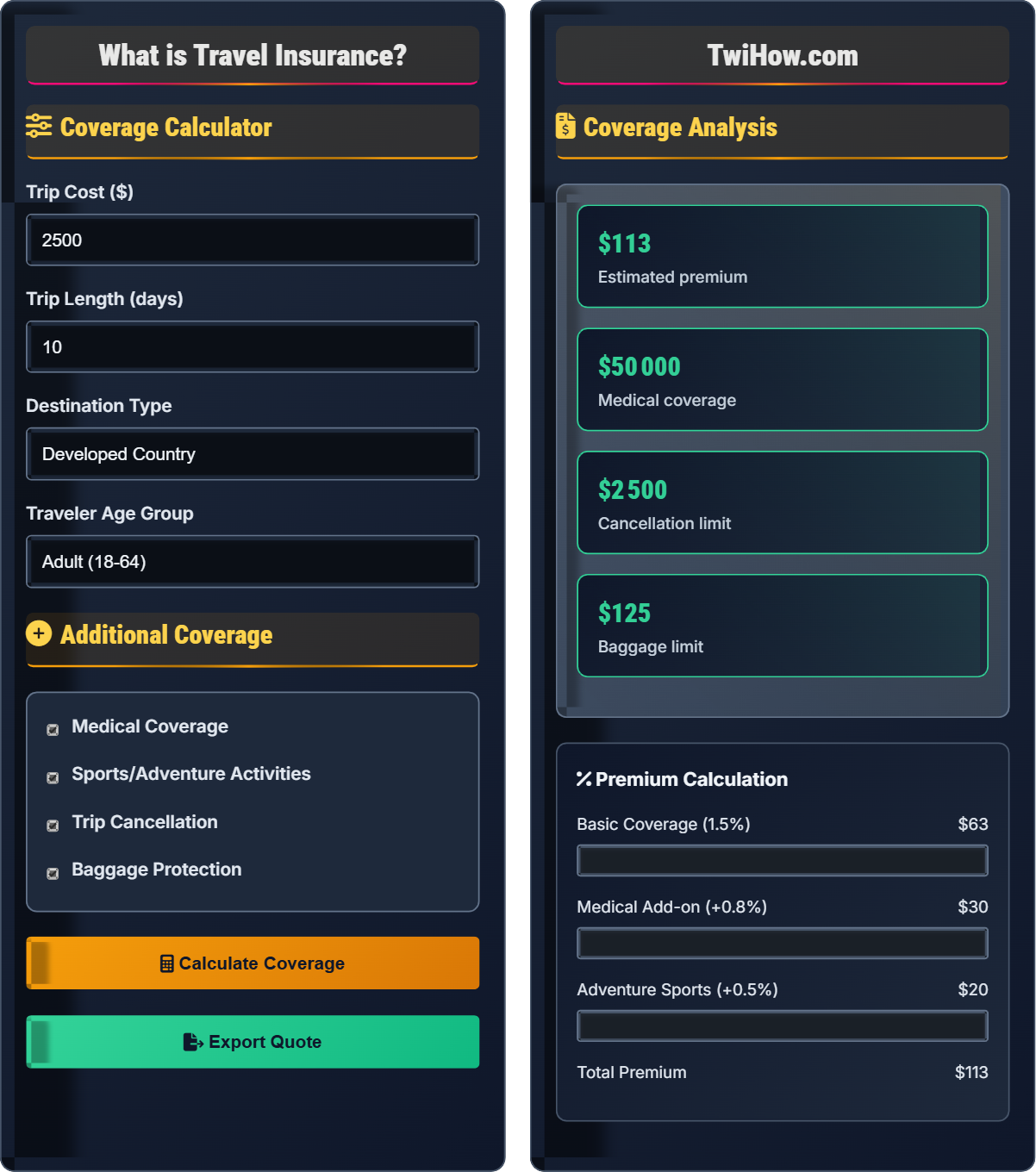
Coverage Calculator
Additional Coverage
Coverage Analysis
Premium Calculation
Our recommended comprehensive plan includes medical coverage, trip cancellation protection, baggage protection, and emergency evacuation coverage.
| Policy Type | Medical | Cancellation | Baggage | Evacuation | Price |
|---|---|---|---|---|---|
| Basic Plan | $25,000 | $1,500 | $500 | No | $87 |
| Standard Plan | $50,000 | $2,500 | $1,000 | $100,000 | $187 |
| Premium Plan | $100,000 | $5,000 | $2,000 | $500,000 | $350 |
| Adventure Plan | $75,000 | $3,000 | $1,500 | $250,000 | $275 |
Understanding Travel Insurance
Travel insurance is a contract between an individual and an insurance company that provides coverage for unexpected losses incurred during travel. It acts as a financial safety net, protecting travelers from various risks that could result in significant expenses or losses.
Key characteristics of travel insurance:
- Provides financial protection against unexpected events
- Covers medical emergencies, trip cancellations, and more
- Offers peace of mind during travel
- Typically purchased before travel begins
- Valid for a specific trip duration
Travel insurance typically covers several key areas of risk that travelers may face:
1. Trip Cancellation/Interruption: Reimbursement for prepaid, non-refundable expenses when a trip is canceled or cut short due to covered reasons.
2. Medical Coverage: Coverage for medical expenses incurred due to illness or injury while traveling.
3. Emergency Evacuation: Coverage for emergency medical transportation or repatriation to home country.
4. Baggage Protection: Compensation for lost, stolen, or damaged luggage and personal belongings.
5. Travel Delay: Reimbursement for additional expenses incurred due to significant travel delays.
While travel insurance provides valuable protection, it's important to understand what is typically not covered:
- Pre-existing medical conditions (unless specifically covered)
- Travel to destinations under government travel advisories
- High-risk activities without proper coverage
- Alcohol or drug-related incidents
- Acts of war or terrorism (in some policies)
Different types of travel insurance policies cater to various travel needs:
Single-Trip Insurance: Covers one specific trip, ideal for occasional travelers.
Annual/Multi-Trip Insurance: Covers multiple trips within a year, cost-effective for frequent travelers.
Group Insurance: Designed for families or groups traveling together.
Specialized Insurance: Tailored for specific activities like adventure sports or medical tourism.
Travel insurance premiums are influenced by several factors:
1. Trip Cost: Higher trip values generally mean higher premiums.
2. Traveler Age: Older travelers typically pay higher premiums.
3. Destination: International travel to high-risk areas costs more.
4. Duration: Longer trips require more coverage.
5. Coverage Limits: Higher coverage limits increase premiums.
Coverage Types
Medical, cancellation, baggage, delay, evacuation, and personal liability protection.
Base premium = Trip cost × Coverage percentage + Additional factors (age, destination, activities).
- Buy insurance soon after booking
- Read exclusions carefully
- Understand pre-existing condition clauses
- Know how to file claims
When to Buy Insurance
Purchase within 14-21 days of initial trip deposit for maximum benefits.
- Pre-existing condition coverage
- Financial protection from booking
- Peace of mind throughout planning
- Maximum coverage options
- Buy immediately after booking
- Compare multiple providers
- Understand your destination risks
- Consider your health status
Real-World Scenarios
Common Travel Risks
Travel Insurance Knowledge Quiz
Which of the following is typically NOT covered by standard travel insurance policies?
Standard travel insurance policies typically exclude pre-existing medical conditions unless specifically covered under a pre-existing condition waiver or rider. This exclusion means that medical issues related to conditions that existed before purchasing the policy are not covered. Trip cancellation due to illness, lost baggage, and medical emergencies abroad are commonly covered under standard policies.
The answer is B) Pre-existing medical conditions.
Understanding policy exclusions is crucial for selecting appropriate travel insurance. Pre-existing conditions represent a significant gap in coverage that many travelers overlook. To get coverage for pre-existing conditions, policies often require purchase within a specific timeframe after initial trip deposit and may require medical documentation.
Pre-existing Condition: Medical condition that existed before purchasing insurance
Exclusion: Circumstances not covered by insurance policy
Waiver: Exception to a policy exclusion
• Standard policies exclude pre-existing conditions
• Coverage may be added with specific riders
• Time limits apply for pre-existing condition coverage
• Purchase insurance soon after booking
• Ask about pre-existing condition waivers
• Disclose all medical conditions
• Assuming all medical conditions are covered
Explain why the timing of purchasing travel insurance matters and what benefits are lost if insurance is purchased too late in the planning process. How does this timing affect coverage for pre-existing medical conditions?
Timing Importance: Travel insurance should be purchased within 14-21 days of making the initial trip deposit. This timing is crucial for several reasons:
Pre-existing Condition Coverage: Most policies offer a pre-existing condition exclusion waiver if insurance is purchased within the specified timeframe after the initial deposit. This waiver covers medical issues related to conditions that existed before purchasing the policy.
Financial Protection: Purchasing early ensures coverage for events that might occur between booking and departure, such as supplier bankruptcy or severe weather warnings.
Maximum Benefits: Early purchase often qualifies travelers for additional benefits like supplier default coverage and cancel-for-any-reason options.
Consequences of Late Purchase: Buying insurance later eliminates pre-existing condition coverage, reduces protection against pre-trip events, and may limit coverage options available.
The timing of travel insurance purchase creates a critical window for optimal coverage. Insurance companies offer enhanced benefits to encourage early purchase, recognizing that early buyers are less likely to have knowledge of events that might lead to claims. This system balances risk management for insurers with comprehensive protection for consumers.
Initial Deposit: First payment made to secure travel arrangements
Pre-existing Condition Waiver: Exception allowing coverage for prior medical conditions
Supplier Default: Travel company going out of business before trip
• Purchase within 14-21 days of initial deposit
• Pre-existing condition coverage requires early purchase
• Early purchase offers maximum benefits
• Set purchase reminder after booking
• Research insurance options early
• Consider annual policies for frequent travelers
• Waiting until close to departure date
• Not understanding timing requirements
• Assuming all coverage is automatic
Mark is planning a 14-day adventure trip to Nepal including trekking, mountaineering, and cultural visits. He has a history of mild asthma and is 55 years old. His trip costs $4,500, and he's traveling alone. Recommend the most appropriate travel insurance policy for his situation, explaining why you chose this option and what specific coverage areas are essential for his trip.
Recommended Policy: Adventure Travel Insurance with Medical Rider
Essential Coverage Areas:
1. Adventure Sports Coverage: Essential for trekking and mountaineering activities that are excluded from standard policies.
2. Comprehensive Medical Coverage: High limits ($100,000+) for remote location medical care and evacuation.
3. Emergency Evacuation: Helicopter rescue and medical transport in remote mountain areas.
4. Pre-existing Condition Coverage: For Mark's asthma, requiring early purchase and medical questionnaire completion.
5. Trip Cancellation: Protection against non-refundable expenses due to medical issues.
Additional Considerations: Nepal's remote location and altitude require higher medical coverage limits and evacuation capabilities. The policy should specify coverage for high-altitude activities.
Adventure travel insurance is specifically designed for high-risk activities and remote locations. Standard policies exclude dangerous sports and may not provide adequate medical coverage in isolated areas. The combination of Mark's age, pre-existing condition, and adventure activities requires specialized coverage that addresses multiple risk factors simultaneously.
Adventure Travel Insurance: Specialized policy for high-risk activities
Medical Evacuation: Emergency transportation for medical treatment
Altitude Sickness: Medical condition from high elevation exposure
• Adventure activities require specific coverage
• Remote location needs higher medical limits
• Pre-existing conditions need early enrollment
• Research specific activity coverage
• Verify evacuation capabilities
• Carry medical documentation
• Using standard insurance for adventure activities
• Underestimating medical needs in remote areas
• Not declaring pre-existing conditions
You're developing a travel insurance claim processing system. Identify the three most critical pieces of information required for each claim type (medical, baggage, cancellation) and explain how the system should prioritize and process different types of claims based on urgency and complexity.
Medical Claims Required Information:
1. Medical reports and treatment documentation
2. Itemized medical bills and receipts
3. Proof of emergency nature of treatment
Baggage Claims Required Information:
1. Baggage claim tags and airline reports
2. Receipts for replacement items
3. Police reports for theft
Cancellation Claims Required Information:
1. Original booking confirmations
2. Documentation of cancellation reason
3. Supplier refund attempts/rejections
Processing Priority: Medical claims should be processed first due to immediate financial impact and health urgency. Baggage claims follow for essential item replacement. Cancellation claims are processed last as they typically involve longer review periods.
Claim processing systems must balance urgency with accuracy. Medical claims require immediate attention due to ongoing treatment needs and financial stress on travelers. The system should have expedited processes for urgent claims while maintaining thorough review for complex cases. Proper documentation requirements ensure legitimate claims while preventing fraud.
Claim Processing: Systematic review and approval of insurance claims
Urgency Levels: Classification of claims based on time sensitivity
Documentation Requirements: Evidence needed to validate claims
• Medical claims require fastest processing
• Proper documentation is essential
• Fraud prevention measures must be in place
• Implement digital documentation upload
• Create claim status tracking
• Provide clear communication channels
• Not prioritizing urgent claims
• Insufficient documentation verification
• Poor communication with claimants
Which of the following factors has the MOST significant impact on travel insurance premium costs?
While all factors significantly impact travel insurance premiums, the trip cost amount has the most direct correlation to premium costs. Insurance premiums are typically calculated as a percentage of the total trip cost, meaning a $10,000 trip will cost significantly more to insure than a $1,000 trip. The premium percentage may vary based on other factors, but the base calculation starts with the trip value.
The answer is B) Trip cost amount.
Travel insurance operates on a proportional basis where the potential payout directly relates to the insured value. Higher trip costs mean greater potential losses for the insurer, resulting in higher premiums. While age, destination, and duration all influence rates, they typically modify the base percentage applied to the trip cost rather than serving as the primary driver of premium calculations.
Premium Calculation: Method used to determine insurance cost
Proportional Basis: Premium relates directly to insured value
Insurance Rate: Percentage applied to trip cost
• Premiums are typically 4-10% of trip cost
• Higher trip values mean higher premiums
• Other factors modify base percentage
• Compare percentage rates across providers
• Consider trip cost accuracy
• Bundle with other insurance for savings
• Underestimating trip cost for insurance
• Not comparing percentage rates
• Ignoring age-based rate increases
Travel Insurance FAQ
Q: Is travel insurance really necessary for a short domestic trip? What could go wrong?
A: While not mandatory for domestic trips, travel insurance can still provide valuable protection:
Trip Cancellation: Unexpected events like illness, family emergencies, or work obligations can force trip cancellation, resulting in lost deposits and payments.
Medical Emergencies: Your regular health insurance may not cover you away from home, especially for out-of-state medical care which can be expensive.
Baggage Issues: Lost, stolen, or delayed luggage can happen anywhere, leaving you without essentials.
Travel Delays: Flight delays or cancellations can result in additional accommodation and meal costs.
For shorter domestic trips, consider whether the peace of mind and protection are worth the cost based on your trip investment and personal risk tolerance.
Q: How do I choose between different travel insurance providers, and what should I look for in the fine print?
A: When choosing travel insurance providers:
Compare Coverage: Look at medical coverage limits, cancellation reasons covered, and activity exclusions. Don't just focus on price.
Provider Reputation: Check customer reviews, complaint ratios, and financial stability ratings.
Claims Process: Look for 24/7 assistance hotlines, online claim submission, and average processing times.
Key Fine Print Items:
• Definition of "covered reasons" for cancellation
• Pre-existing condition limitations and waivers
• Maximum coverage limits per person/per trip
• Deductibles and co-payments
• Activity and destination exclusions
• Time limits for filing claims
Consider working with a licensed insurance agent who specializes in travel insurance for complex needs.